Thursday, September 10. 2015
Cover and label variants of Chess LP-1485 Greatest Hits

CBID is never complete as new records and CDs appear and some old rarities are discovered. This section presents interesting additions and corrections to CBID.
Today: After we have seen that there were three different versions of the cover of Chess LP-1480 Chuck Berry On Stage it is time to explain that the same variants (initial print, sticker, and final print) can also be found with Chess LP-1485 Chuck Berry's Greatest Hits.
USA
CHUCK BERRY'S GREATEST HITS
Chess LP-1485 ? April 1964
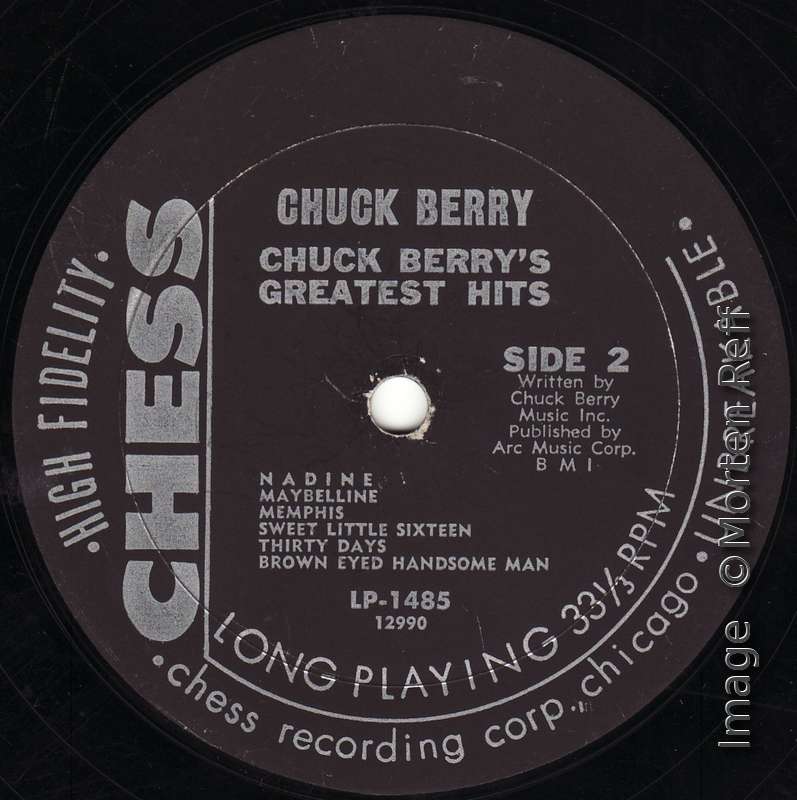
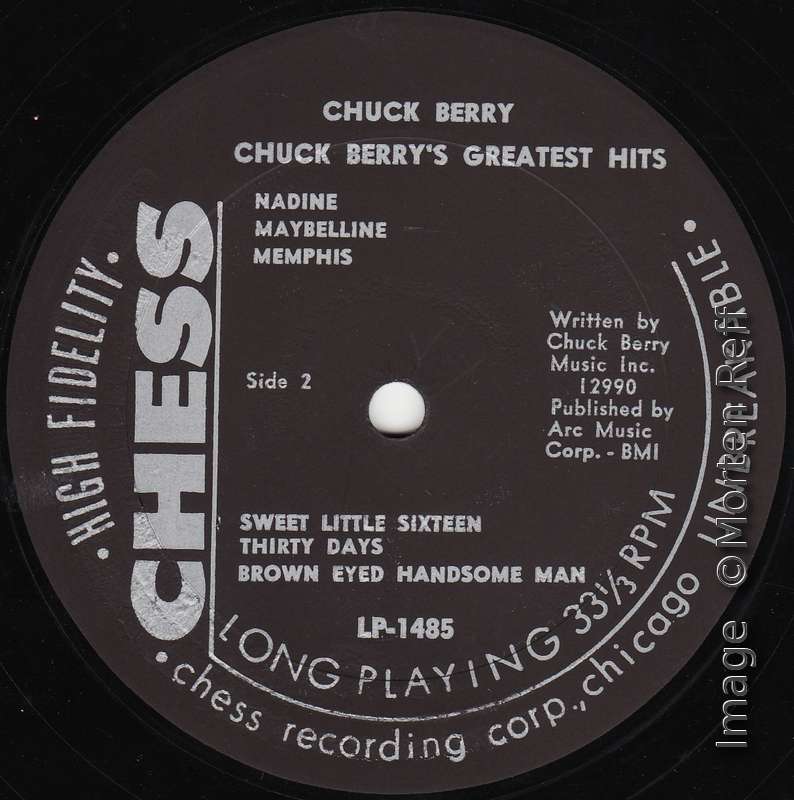
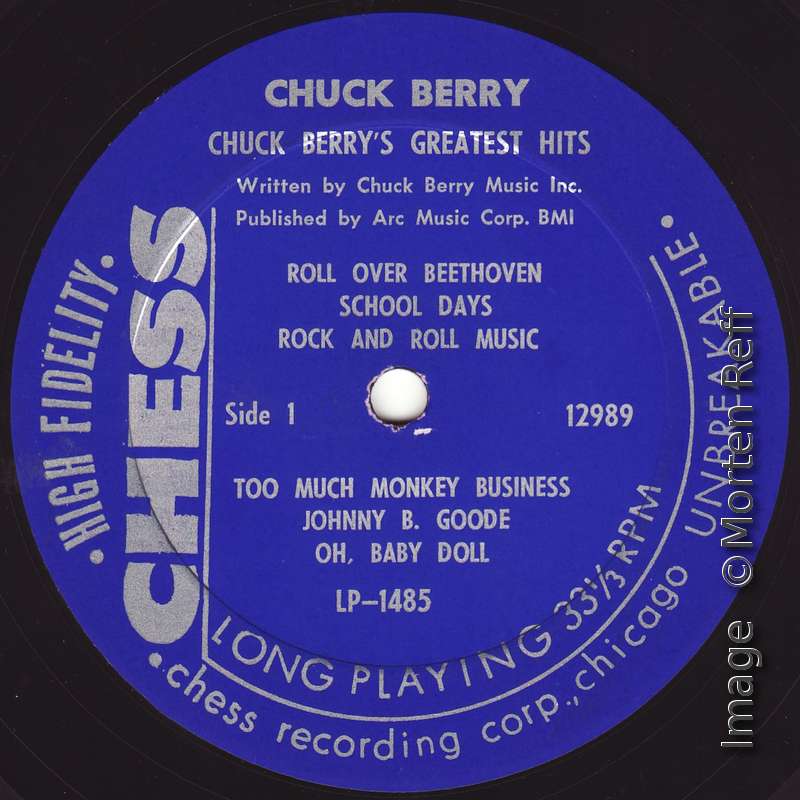
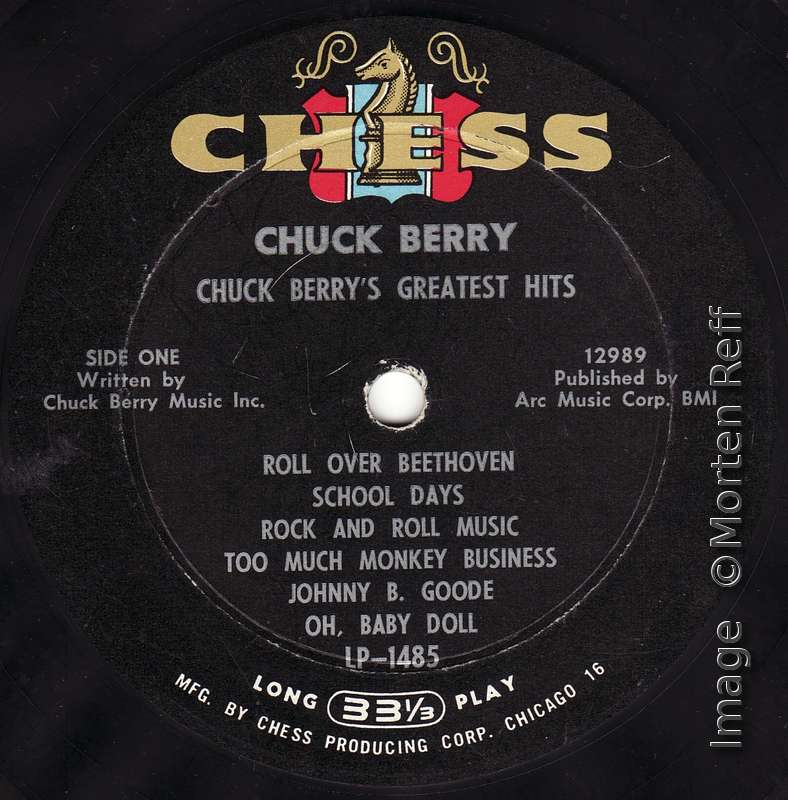
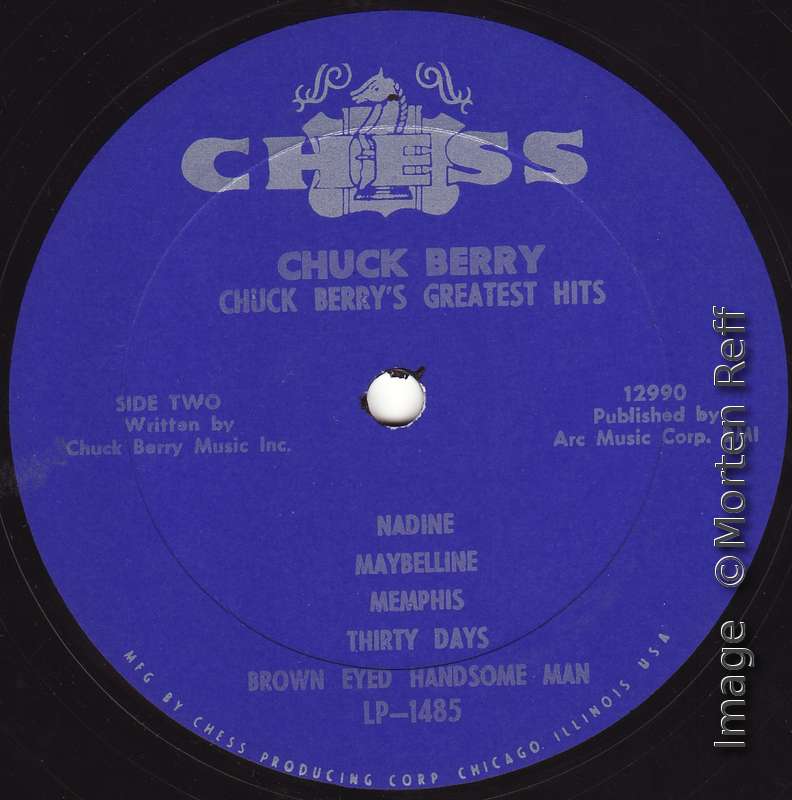
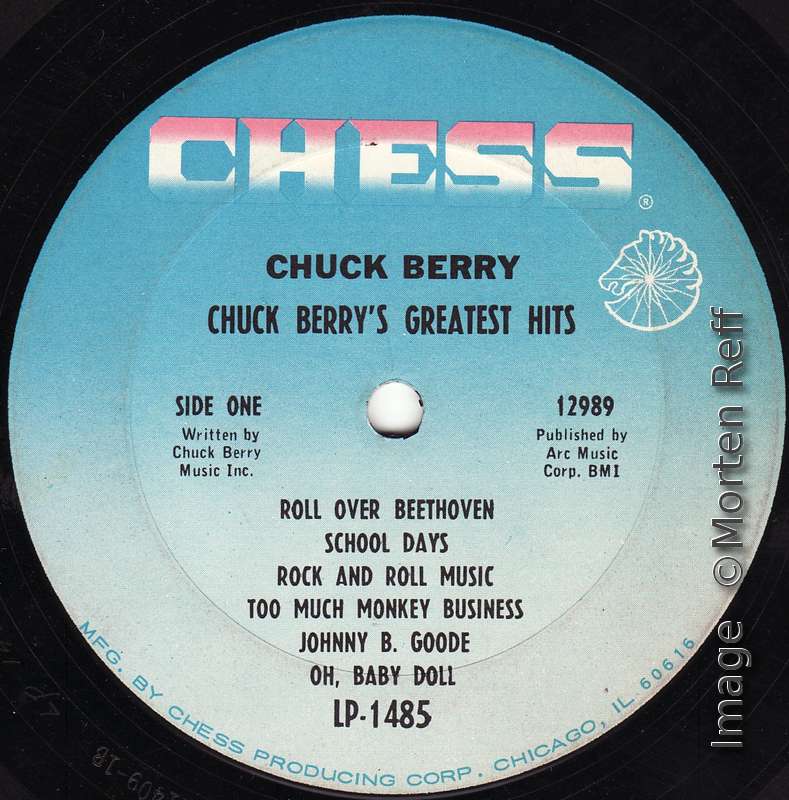
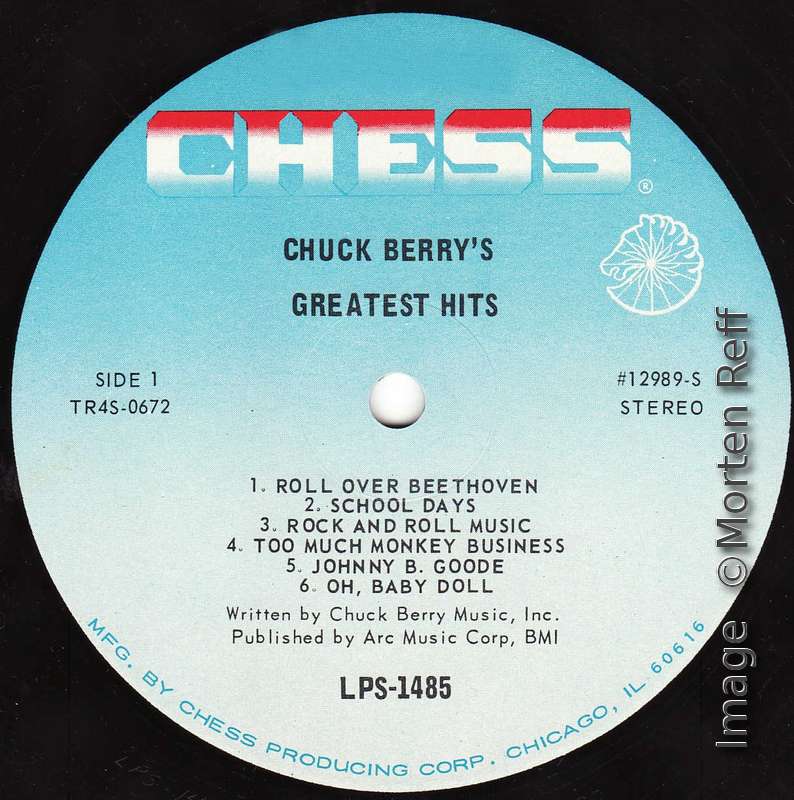
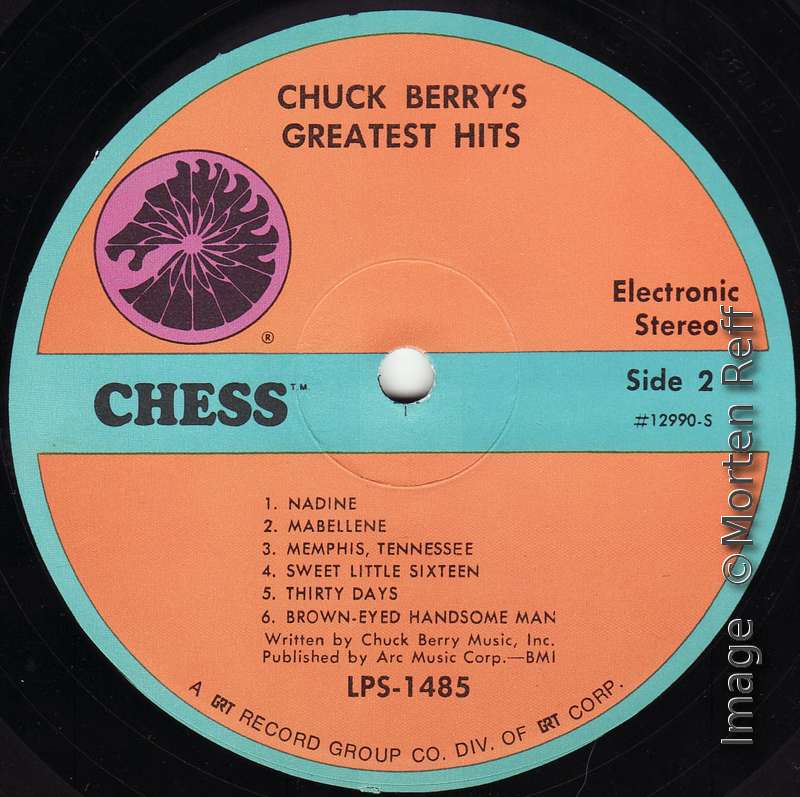
This is another of those Berry LPs that has come out with countless of label variants, 8 to be exact, and three different front covers, four if you count the el.stereo one numbered LPS-1485. The first cover didn’t have the titles in black on a yellow sticker or printed in yellow in the bottom right-hand corner (see images). And it’s not easy to tell for sure which label was the first, but I would guess it was the old black label with the vertical silver Chess logo (again see all the various images).
And it was also the first occasion that “Maybellene” was spelt with an ‘i’. And take notice of the different spelling, Featuring the original hits on the sticker, contra the later printed version Featuring the hits.
here are the four covers of Chess LP-1485. As with all images on this site you can enlarge it by clicking.
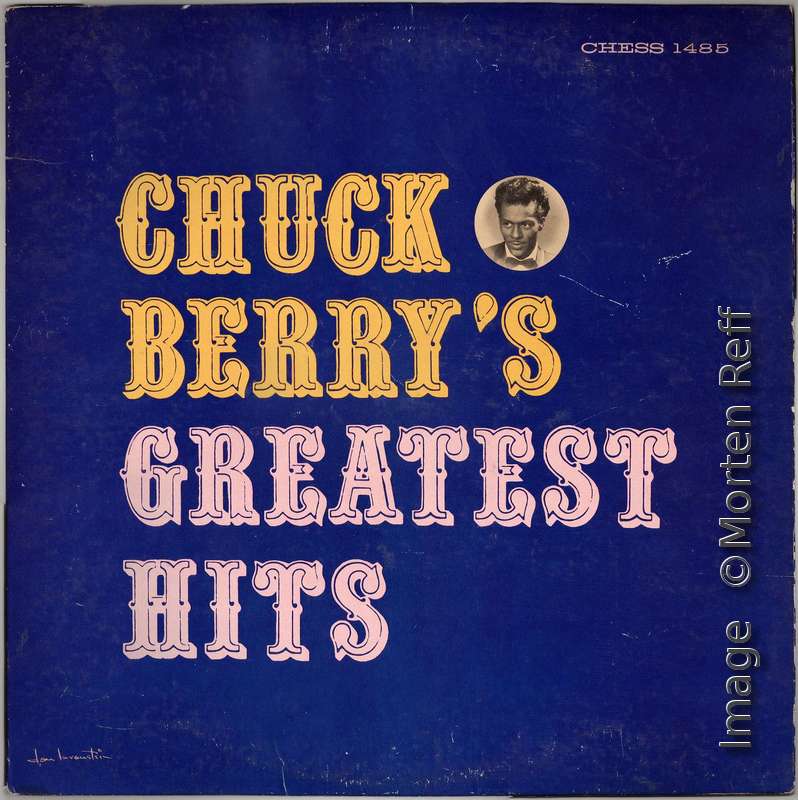
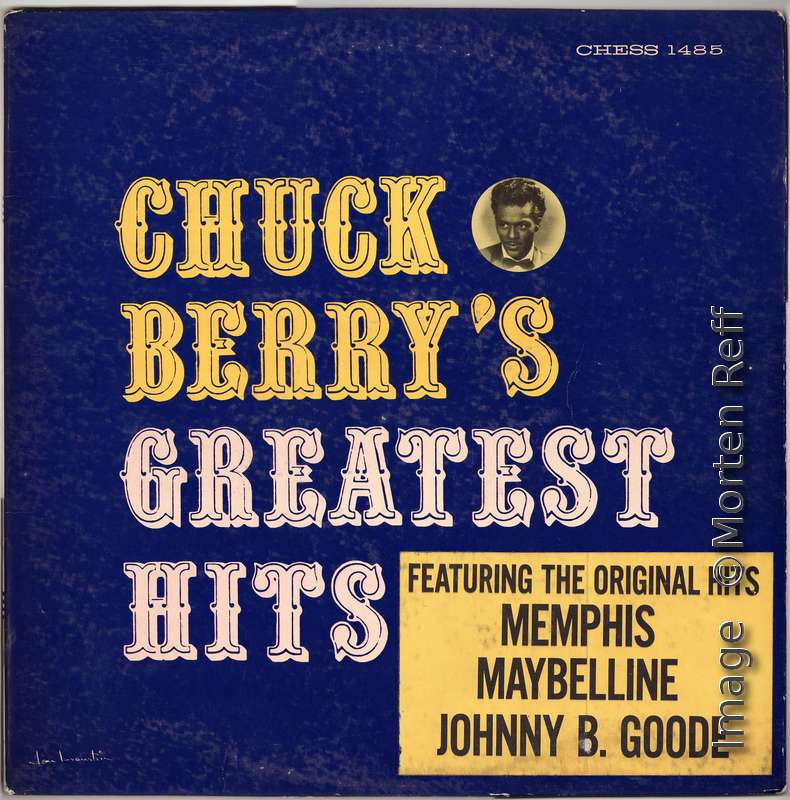
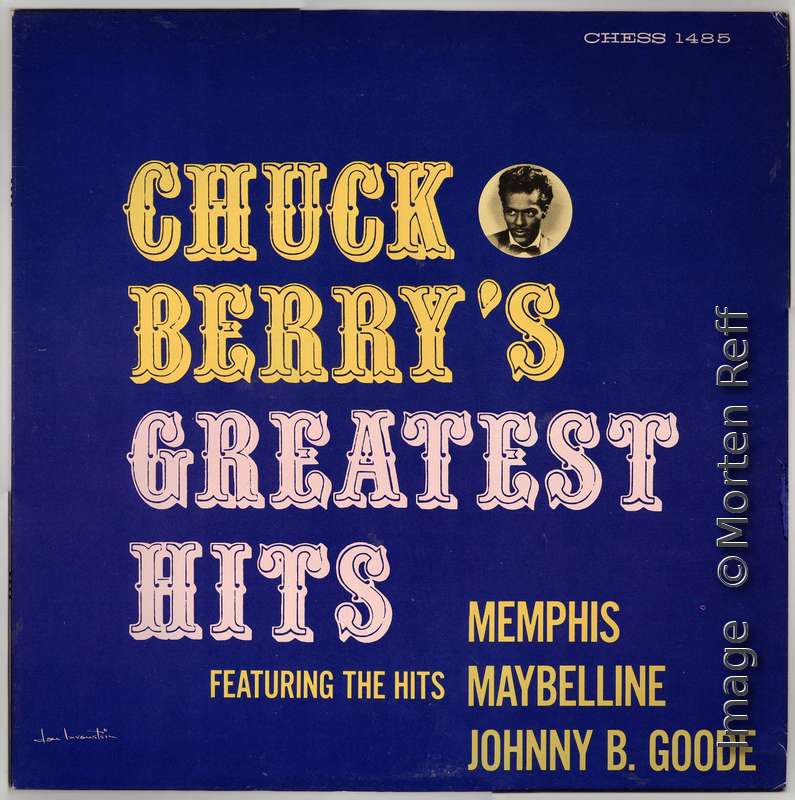
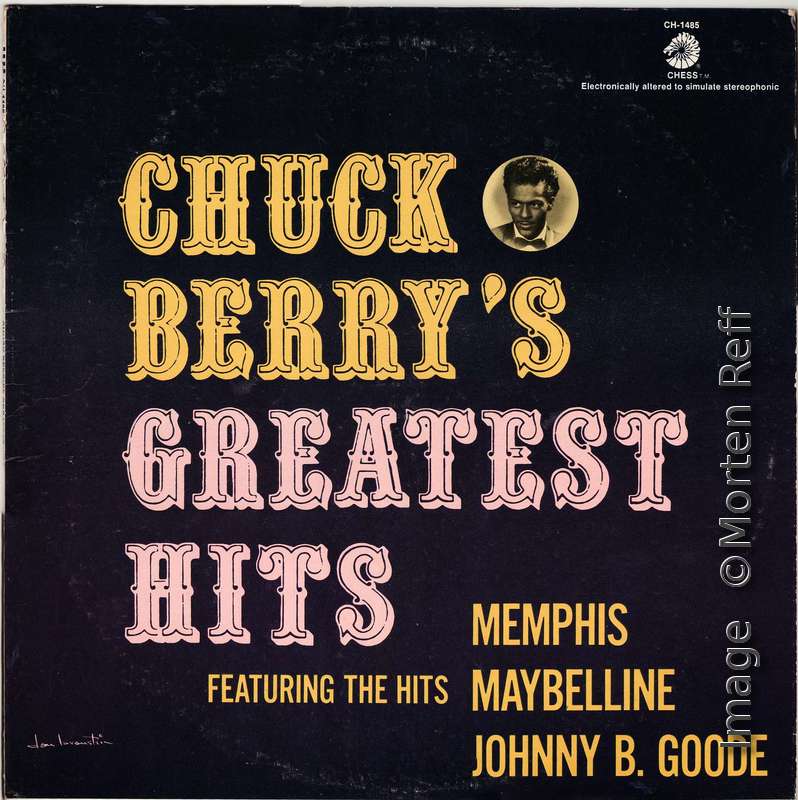
And here's a selection of labels I have found with this Greatest Hits album.
Thursday, September 3. 2015
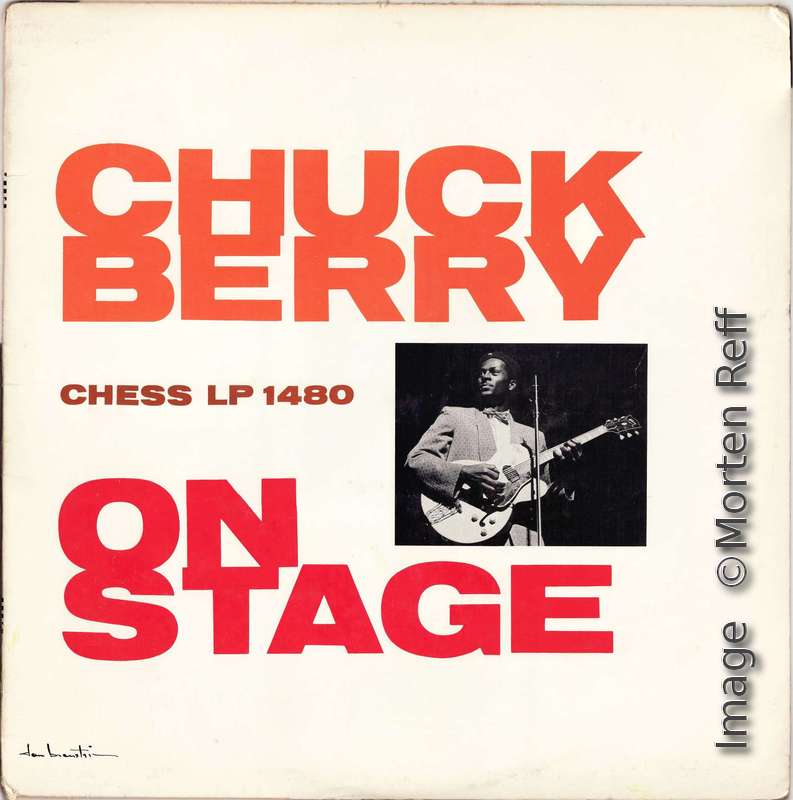
CBID - The original cover of Chess LP-1480
CBID is never complete as new records and CDs appear and some old rarities are discovered. This section presents interesting additions and corrections to CBID.
Today: As already discussed in some blog posts here, the initial release of Chess LP-1480 was missing from the book - and all other discographies.
USA
CHUCK BERRY ON STAGE
Chess LP-1480 • August 1963
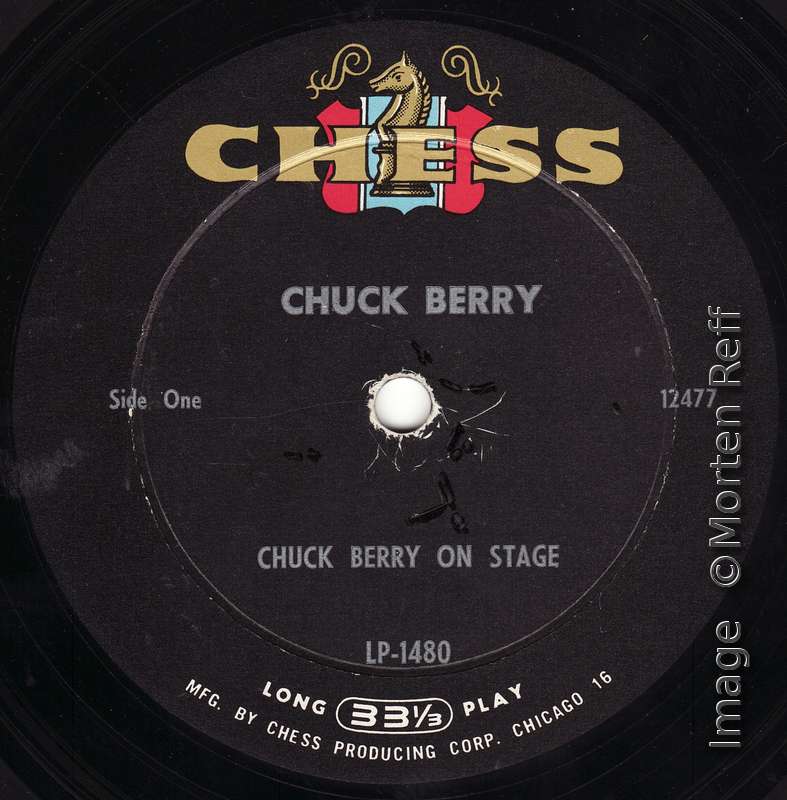
As mentioned on pages 60-61 I said that the original pressing of this LP had a sticker on the front cover. It goes to show that actually the original very first issue of this album didn’t have the sticker but came with no titles printed on top. Also the label was the black label with the fancy gold Chess logo across the top (image page 60) and no song titles mentioned. So now finally we have the complete picture of this LP.
Monday, August 10. 2015
Crying Steel's Third Strike - Chuck Berry and Keith Richards live 1986
Their first release 'Deliver Me From The Days Of Old' (Crying Steel Records CSR001, 2007) contained all of Berry's Records which I had described as being released on CD or Vinyl before but concurrently being extremely hard to find on CD. This included the Newport 1958 concert which was back then only available in Sweden or the two Japanese concerts which were at that time only available on Vinyl.
While it is doubtful that CSR001 was a legal release, it not only looked like one. It also came with a professional booklet containing many great photos and useful discographical information.
Crying Steel's second release 'Live At Winterland, San Francisco '67' (Crying Steel Records CSR02, 2014) gave us a CD copy of the three 1960s concerts which had been found in the archives of promoter Bill Graham. These had been made available for online listening through the commercial site Wolfgang's Vault, now Concert Vault. I reported on these concert in blog entries here on January 12, 2008 and on October 23, 2009.
Again it is doubtful whether Crying Steel had the rights to publish Graham's recordings of Berry's performances. But it is also not clear whether Concert Vault has the right to broadcast thise in the first place. See this recent article from Billboard.

Now I received Crying Steel's third strike: a CD called 'Long Live Rock 'n' Roll - 60th Birthday Celebration' (Crying Steel Records CSR03, 2015). Source for this CD is another concert recording available for listening at concertvault.com
I had reported on the availability of this recording in October last year in this site's chapter on Berry's 60th Birthday Celebrations. This concert was recorded on October 17, 1986 and is the second show from the Fox Theatre, St. Louis used for the preparation of Taylor Hackford's documentary called 'Hail! Hail! Rock 'n' Roll' (released 1987). For all the details on this show read the corresponding chapter of the main site.
The Concert Vault recording of the show is about 85 minutes long. It contains most of the concert including various stage banter and impromptu jamming. To make it fit on a single CD, Crying Steel Records excluded most of the in-between talks/waits as well as some of the instrumental jams. Instead they added one more recording from this show: 'School Day' was the big finale of the show as it can be seen in the movie. It was missing from Concert Vault, though.
As no good quality first-hand recording of this final track was available, the people at Crying Steel copied it from the movie, probably from one of the commercially available DVDs. While doing so, they concurrently also extracted four other live recordings from the movie: 'No Money Down', 'Nadine', 'Almost Grown', and 'No Particular Place To Go'. These had been included in the film, but were recorded during the other of the two shows. Just like the remaining songs from the first show which were used in the film or on the soundtrack album, these audio tracks have been post-produced in Los Angeles. During this post-production some vocal parts were overdubbed. I have not yet had the time to compare the post-produced versions to the original recordings where available.
Together with the original soundtrack album, the Crying Steel CD presents a nice overview of the two Fox Theatre shows. They even added two of the Cosmopolitan Club performances also seen in the movie.
As the broadcast on Concert Vault splits the concert into individual tracks, Crying Steel made some effort to glue these parts back together. In most cases this worked quite well. Sometimes volume or cuts do not match correctly, though. They also did not notice that the introduction for Eric Clapton was included twice by error. Finally I found it irritating that at least during the Etta James segment they re-ordered the sequence of the recordings.
Again this professionally looking CD comes with a nice six-page booklet containing photos taken during the Fox Theatre shows. I really don't like the outlook of the track listing and the liner notes, though. Like with last year's release they took a strange, almost unreadable font. And the type size is so small you need a magnifying glass to read it. So, Crying Steel Records, if you read these comments, please return to the CSR001 style!
And I really wish these recordings would be released in a way that the artists, composers, and producers would get their share from the income. I'd be glad to pay.
Thursday, August 6. 2015
CBID - South African Releases on TEAL
CBID is never complete as new records and CDs appear and some old rarities are discovered. This section presents interesting additions and corrections to CBID.
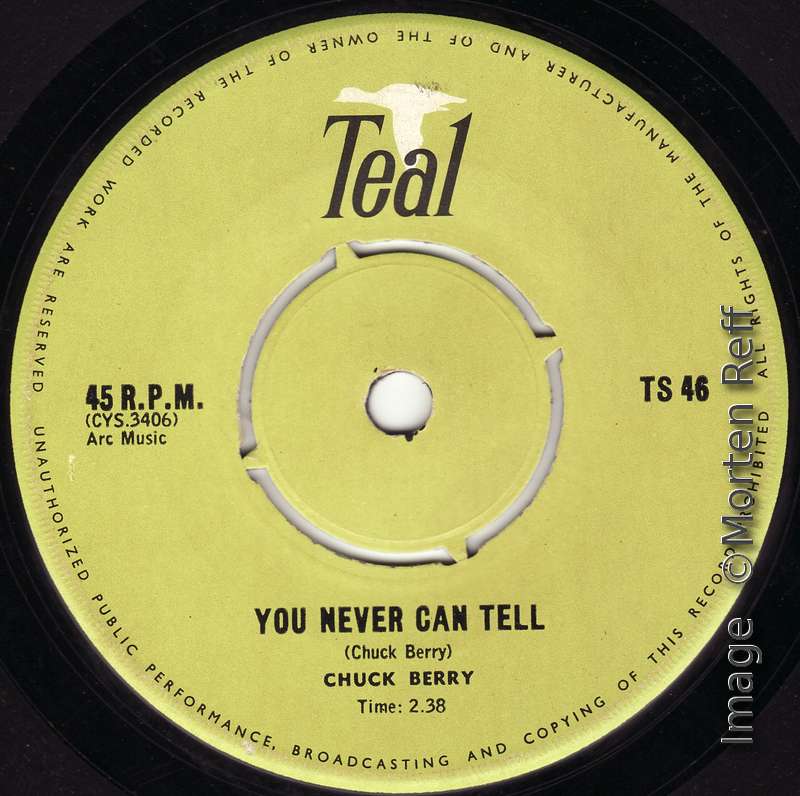
Today: Here’s another 45 from South Africa which wasn't known when Volume 1 got out.
SOUTH AFRICA (pages 445-446, 2018-2019)
You Never Can Tell / Brenda Lee
Teal TS-46 ? 1964
The three other light green Teal singles we know have the prefix TSP, don’t know why this one only has TS. Now it seems like we at least miss 'Promised Land' which I am sure was also released in South Africa. Remember that they coupled 'Nadine' and 'No Particular Place To Go' on the same 45, TSP-41 (page 446).
Thursday, June 25. 2015
CBID - The Missing Twin
CBID is never complete as new records and CDs appear and some old rarities are discovered. This section presents interesting additions and corrections to CBID.
Today: In an addition to the French discography written here on October 18, 2014 I presented two completely different cover variants of "Chuck Berry, Vol. 2" (Impact 6886 407). I wondered whether there would be also a second cover variant of Volume 1 (Impact 6886 403). Finally the other day (actually 2 weeks ago) I spotted on eBay the other, or the first, issue of Impact 6886 403 with a diferent cover image. And again a much better one.
FRANCE
CHUCK BERRY (different cover)
Impact 6886 403 ? 1979
Same tracks and catalogue number as the 1980 issue (page 309), but with a different and much better front cover image. Images show the first variant (left) and the second (right).
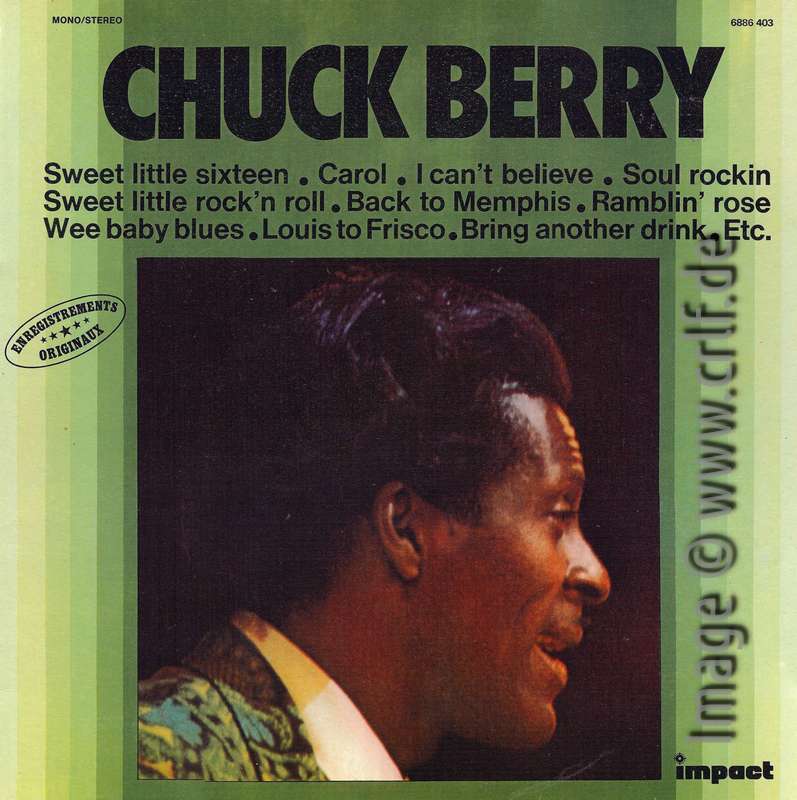
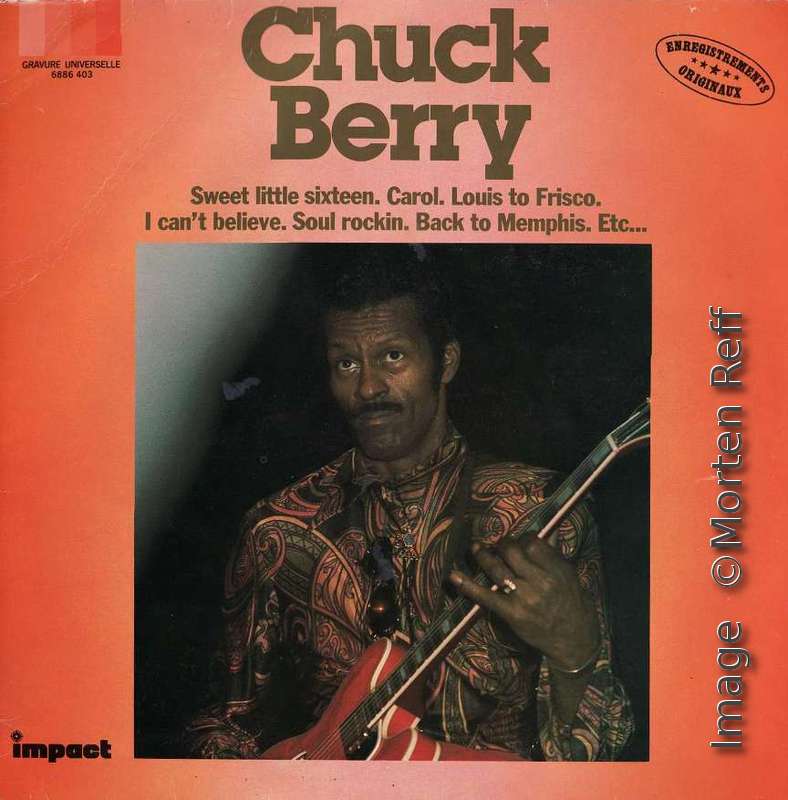
The release dates of these albums (1979 or 1980) are unconfirmed, also which one of the variants came first. If you know, tell us!
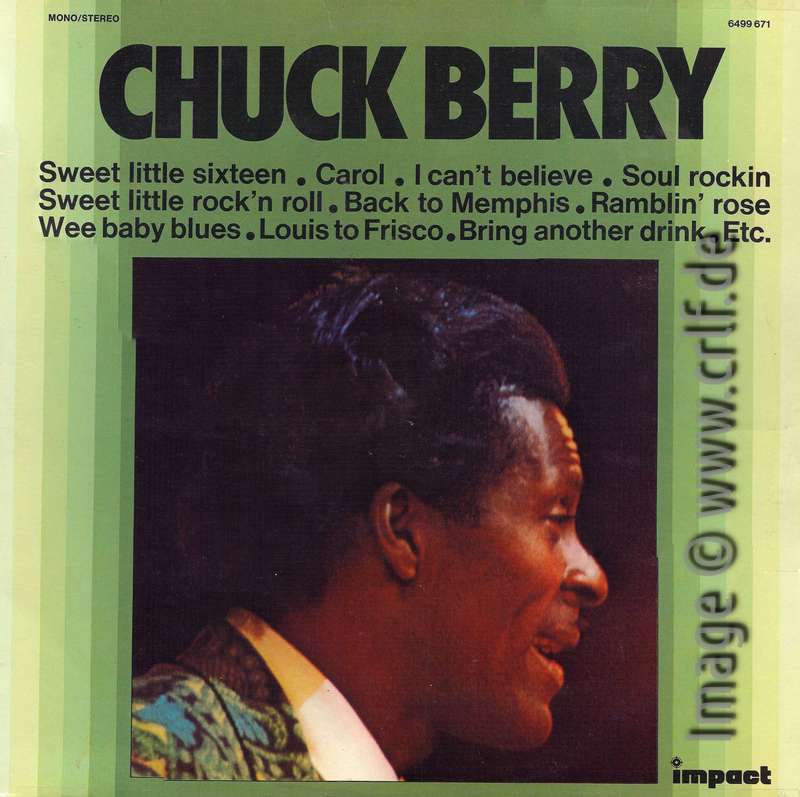
Update: As said on page 309, there is another variant of this record. It has the same name and contents as well as an almost identical cover but lists a different catalogue number in the upper right corner: Impact 6499 671. For completeness this cover is shown below. I had described this as a 1981 reprint. However, the lower catalogue number indicates that this variant came first. Also the red label of Impact 6886 403 as well as the wax show the lower number of the yellow label release as the matrix number for the higher number record. Again a release date of this record is unknown.
Thursday, June 18. 2015
CBID - Another Sixteen Berry Covers
CBID is never complete as new records and CDs appear and some old rarities are discovered. This section presents interesting additions and corrections to CBID.
Today: Here’s a new batch of Berry covers I have collected lately to be added to the chapter on Chuck Berry covers in Volume 3. It never stops!
BIG BAD VOODOO DADDY (USA)
A swing revival 7 piece band from Southern California (Ventura) very influenced by the music of the ‘40s and ‘50s. Leader Scotty Morris (vocals and guitar) formed the band in 1989 and they have released over 10 albums since then.
Run Rudolph Run (3:58) 2013
CD: It Feels Like Christmas Time [Savoy Jazz SVY-17921] ? USA, 2013
Yes, it is a swing version which is actually the first one I have heard of this Xmas ditty in that genre. It’s always interesting to find new unusual versions of a Berry song.
DION (USA)
See Volume 3, page 1161 for biographical info.
Too Much Monkey Business (4:36 ) 1971 (live)
CD: Recorded Live At Bitter End, August 1971 [Ace CDCHJ-1433] ? UK, 2015
Recorded live at the renowned New York folk venue the Bitter End. I have always loved Dion and his way of performing a song, making it different and this is no exception. It’s not rock’n’roll but more like ‘70s folk country blues. And Dion is actually a mighty fine guitar player too.
KENTUCKY HEADHUNTERS with JOHNNIE JOHNSON (USA)
See Volume 4, page 1627, and Volume 3, page1276 (Johnnie Johnson) for biographical infos.
Little Queenie (3:32) 2003
CD: Meet Me In Bluesland [Alligator ALCD-4965] ? USA, 2015
The song has a very solid beat but it’s Johnnie who’s the real hero on this one. Excellent piano throughout and especially on the solo. The album feature Johnnie on all 11 tracks. Recorded 26-28 January 2003 at Barrick Recordings Studio, Glasgow, Kentucky.
EDIE LENORE (USA)
Search on the net discovered that Edie was a Hee Haw Country music star during the time of recording the single below.
Johnny B. Goode (2:48) 1973
45: JEM Records J-528 ? USA, 1973
Record label out of Nashville, Tennessee.
LINCOLNS (Australia)
Four piece rockabilly band from Adelaide, Australia.
You Never Can Tell (2:43) 2015
CD: Teddy Boy Rock’n’Roll [Raucous RAUCD-274] ? UK, 2015
Good, tradional version featuring a solid beat and an effective guitar solo (instead of piano). I know it might sound crazy but I got the Buddy Holly feeling in this.
LO-LITES (Finland)
Rock band from Helsinki. Three piece playing loud and raucous music called rock’n’roll but maybe a little over the top.
You Can’t Catch Me ( : ) 2015
CD: Can’t Saddle Me ! [B-Top BTOP-005] ? Finland, 2015
MIMES (Austria)
Rock quartet of whom I have seen 3 single releases altogether.
Carol [Oh Carol] (2:52) 1968 (live)
45: Amadeo AVRS-21519 ? Austria, 1968 (picture sleeve)
ORCHESTER BERT LANDERS (West Germany)
Another orchestra leader in the line of James Last…
Memphis, Tennessee (1:26) 1964 (instr)
LP: Schlager Derby 1964 [Tip 63-3025] ? West Germany, 1964
LP: Schlager Runde Folge 2 [Tip 63-3027] ? West Germany, 1964
JOHNNY SPENCE & DOCTOR’S ORDERS (UK/Finland)
See Volume 3, page 1526 for biographical info.
Let It Rock (2:10) 2015
CD: Kickstart Your Mojo [Goofin’ GRCD-6183] ? Finland, 2015
Played in the style of the latter-day Pirates..
STATUS QUO (UK)
See Volume 3, page 1531 for biographical info.
Bye Bye Johnny (6:09) 2014 (live)
2 CD: The Frantic Four’s Final Fling [Ear Music 0209552 ERE] ? UK, 2014
Live in Ireland at the Dublin 02 Arena 12 April 2014, featuring Rossi and Parfitt with original founding members Alan Lancaster (bass) and John Coghlan (drums).
SWEET GEORGIA BOYS (UK)
This is piano player Jim Hammond and drummer Bill Crittenden. The Kingbeats is a link here. The album below is NOT a Christmas release. There are no other Yuletide songs except Berry’s. The album is in the boogie woogie rock’n’roll style.
Run Rudolph Run ( : ) 2014
CD: Jump For Joy [Foot Tapping FT-152] ? 2014
HANS THEESSINK (Netherlands) & TERRY EVANS (USA)
See Hans Theessink volume 3, page 1557 for biographical info.
Maybellene (6:06) 2015 (live)
CD: True & Blue – Live [Blue Groove BG-2520] ? Austria, 2015
Recorded live in Vienna. At such a length it must be the longest cover version of this classic. A real acoustic beauty with an extended instrumental break.
CONWAY TWITTY (USA)
See Volume 3, pages 1578-79 for biographical info.
Memphis, Tennessee ( : ) 1964 (live)
2-CD: Rocks At the Castaway [Bear Family BCD-17413] ? Germany, 2015
Recorded live at the Castaway Geneva-on-the-Lake nightspot 3-9 August 1964.
VIKINGS (Norway)
Tore Andersen,Åge Haugan, Bjørn Schandy, Jan Erik Gustavsen and Børre Nilsen. A combination of dance band and country group.
Let It Rock (3:08) 1985
MC: T.R.A.C.K.S [WC85 1001] ? Norway, 1985
Credited to C. Berry and not E. Anderson, but the arrangement is based on the cover version (‘Let It Roll’) by Mel McDaniel from 1985. Although they didn’t succeed in getting the song to roll.
WHITNEY WOLANIN (USA)
She’s a pop singer/songwriter, born 1990 in Albany, New York, growing up in Florida. Released her debut album ‘Funkology XIII’ in 2005.
Run Rudolph Run (3:01) 2013
CD EP: Run, Run Rudolph [Top Notch Records, unk. cat no] ? USA, 2013
5 song EP. Now this a better version which has some rock & roll feeling and beat to it. On this special EP it comes in three different mixes, Up-Tech, Sing Along and Country. The song reached #2 on the US Billboard Adult Contemporary chart, December 2013. Whitney and her sister Victoria operates the Top Notch Record label. “I was especially drawn to the song because of how lively it is – it’s one of those songs that make people dance”. “I love Chuck Berry’s version, I really do but I wanted to modernise it a little but keeping the essence of his guitar riffs.”
BILL WYMAN’S RHYTHM KINGS (UK)
See Volume 3, page 1615 for biographical info.
Johnny B. Goode (7:05) 2008 (live)
CD: Live Communication [Repertoire REP-5170] ? Germany, 2011
From their sell out 2008 UK tour.
Wednesday, March 25. 2015
The Johnny B. Goode Session
When Fred Rothwell a few weeks ago reported here on his new findings regarding the 'who-played-on-what' questions of Chuck Berry's discography, one of the most interesting changes to the Chuck Berry sessionography was made to the personnel which created Johnny B. Goode.
The session's recording contract encountered by Tim McFarlin during his studies of the Berry vs. Johnson suit of 2000-2002 lists Johnnie Johnson as piano player for the recording session dated January 6, 1958. According to what is listed in the discographies, this is the session in which Johnny B. Goode was recorded. Formerly, Fred and other experts had listed Lafayette Leake on piano.
Fred‘s sessionography change first got various comments posted here on the blog and then resulted in almost two months of (sometimes heated) discussions in email to which Berry experts from the U.S., from the Netherlands, from England, France, Norway, and Germany contributed.
In the end we had to agree that we do not agree on a common opinion. However, as this topic is of interest to most Berry collectors I will try to sum up the facts and the most important opinions.
Speaking of facts we found that we have astonishing few 'hard facts' to base any discussion or result on.
This starts with the date of the session which generated Johnny B. Goode. Depending on which source you consult the reported recording date for this song is February 28, 1958 (Michel Ruppli, The Chess Files) or December 29, 1957 (Mike Leadbitter/Neil Slaven, Blues Records). Berry's Autography has the date listed as February 28, 1958 as well. Who is correct? We have some hints:
We know that Chess Records assigned the matrix number 8633 to the final recording and mix of Johnny B. Goode. We also believe that Chess assigned matrix numbers in the sequence the master tapes were finished. The matrix numbers directly following Johnny B. Goode were assigned to different artists: The Pastels (8634/35), The Lewis Sisters (8636-40), Harvey & The Moonglows (8641-43), and so on. The next numbers assigned to Chuck Berry records are 8656/57 (A and B sides of EP 5121 Sweet Little 16), 8689/90 (side 1 and 2 of LP 1432 One Dozen Berrys). The next Berry recording Around And Around is sixty numbers after Johnny B. Goode and got the matrix number 8693. This points to at least a couple of weeks between the mastering of Johnny B. Goode and that of Around And Around. And if we assume that mastering in the 1950s was done either concurrently with the recording or soon thereafter, this also points to a couple of weeks between the recordings of the two. As a sidenote: From later sessions we know that songs recorded the same day got master numbers a dozen or so numbers off, probably because the mastering of the later songs was delayed.
Of more interest are the master numbers preceding Johnny B. Goode. They all are assigned to Chuck Berry recordings: Sweet Little Sixteen (8627), Rock At The Philharmonic (8628), Guitar Boogie (8629), Night Beat (8630), Time Was (8631), and Reelin' And Rockin' (8632). This means that all these songs including Johnny B. Goode have been mastered/recorded in one session or a set of consecutive sessions, in any case so close to each other that no other masters were made in between.
This is the reason why both Michel Ruppli and Leadbitter/Slaven had all seven songs listed as a single session. If this would be true, Ruppli's session date of February 1958 cannot be correct because Sweet Little Sixteen was already in the stores by January. Chuck Berry's list of recording sessions as published in his book places the six early songs (masters 8627 to 8632) in a session dated January 6, 1958 while he puts Johnny B. Goode (8633) along with Around And Around (8693) and five other songs (masters 8694 to 8696) to February 28.
When compiling his sessionographies, Fred Rothwell took the most probable route. He placed the recording of the consecutive masters 8627 to 8633 close together, i.e. put Johnny B. Goode close to Reelin' And Rockin'. However, because we know that the released version of Sweet Little Sixteen was take 14 and the released version of Reelin' And Rockin' was take 10, Fred had strong doubts that all these were recorded the same day. It would have been an awful long session. Therefore he used the December date from Blues Records for Sweet Little Sixteen and Chuck Berry's January date for Johnny B. Goode. These recording dates are so close together that consecutive master numbers are probable.
The session contract encountered by Tim McFarlin during his research of the legal papers filed for the 2002 lawsuit lists a date and personnel, but in contrast to later contracts it unfortunately does not give us a list of songs recorded. Thus if we believe the recording contract — and we should as the other contracts make perfect sense —, we know that a session took place on January 6th, 1958 (the date from Berry's book) and that personnel included Johnnie Johnson on piano.
Is this a proof? No, because you can argue that we don't know of a contract for a December session (yet?), that there is no list of songs, that there may be other sessions between January and March 1958 (when Johnny B. Goode hit the stores). But placing the recording of Johnny B. Goode (and maybe the others) with the January session sounds reasonable given the information we have.
Other information we have is an audio protocol of what happened at the session which generated Johnny B. Goode. The recording tapes of this session have survived and have been released to the public. So they form some additional 'hard facts' we may base our discussion on.
From the tapes we know of three tries to record the song during this session. To judge the audio recordings one has to take into account that the released versions are not labeled correctly.
The correct sequence of the recordings has been discussed here in a blog post dated July 26, 2011:
Johnny B. Goode - take 1: was first released in 1986 on CHESS CH2-92521 "Rock 'n Roll Rarities" as the second part of a track named "Johnny B. Goode — previously unreleased version".
Johnny B. Goode - take 2: is a very brief take which starts correctly but is then interrupted. This second take has been released twice: Complete with the announcement "Johnny B. Goode Take Two" on Hip-O Select's "Johnny B. Goode - His complete 1950s recordings" and without this announcement but with a false start as the first part of the previously unreleased version on "Rock 'n Roll Rarities". Note that the sequence of the two takes is reversed on the 1986 release. Also note that the Hip-O set misses take 1 completely. It is only on the 1986 double album.
Johnny B. Goode - take 3: exists in two variants. The original recording of this take without any overdubs was first released on the Hip-O Select set in 2008.
Johnny B. Goode - take 3 including guitar overdub: This is the 1958 hit version. Like on many other recordings, Berry on take 3 played just the first part of the lead guitar intro but then continued playing the rhythm guitar. The remaining parts of the guitar intro as well as further guitar solos were recorded and overdubbed later, probably during the same session.
Again this provides us with some more facts, but how much of this can be considered as 'hard facts'? The takes are introduced as takes one, two and three. Take 3 is the basis of the final released record. So we can assume that there were no other takes. The final master (8633) however is a modified version of take 3. The most obvious modification is the addition of further lead guitar segments.
Another possible modification is a manipulation of the playback speed. It is known that Chess Records modified the playback speed of Sweet Little Sixteen to make Berry's voice sound younger. When a sound recording is played faster, the pitch becomes higher with the voices sounding lighter.
With Johnny B. Goode such a modification is not as obvious as with Sweet Little Sixteen. The running times of the undubbed take 3 and of the final master are almost identical. Whereas we have to keep in mind that we have access to the final master only in the form of 45 rpm records and digital copies like the one on the Hip-O Select box.
Just for academic purposes (and without any other use anyway) I have created myself an audio file in which one can hear the beginning of both variants of take 3 of Johnny B. Goode. The left stereo channel is the un-modified take 3, the right stereo channel contains the released master. One notices the overdubbed guitar which is now to be heard on the right channel only. And one can notice that there is a tiny difference in speed. It sounds as if the released master indeed has a slightly higher pitch and runs a little bit faster.
[I have asked Universal Music for permission to provide readers with a download link to this audio file. I have not received any permission nor any response at all, though (yet).]
What does this tell us about the recording session itself? Very little. We have no information when the guitar overdub was recorded and how. In the late 1950s there was no multi-track tape recording at Chess. Thus it is probable that the original take was played back into the studio where Berry then added the missing guitar lines. This is also where the speed difference may come from: The tape played back on a different machine and then re-recorded along with the solo guitar.
All we can tell for sure is that the mastering of the overdubbed take happened in temporal proximity to the mastering of Sweet Little Sixteen which in turn obviously happened before that song's release in January 1958.
In regard to the discussion on who was the pianist on Johnny B. Goode the differences between the three takes are relevant. Comparing the takes, it is obvious that Berry pretty much knew how he wanted the guitar to sound like. The main difference between the complete takes 1 and 3 is the piano playing. And how important this piano playing was becomes audible from the discussions taking place during take 2.
Take 2 starts just normal with the famous guitar intro. Then, when the piano comes in, someone shouts "hold it" and a dialog starts which I interpret as follows. To better understand the different sentences, I created another sound file in which I tried to level the loudness of those said through a microphone and those said without.
[Again I wanted to provide a download link to this sound-enhanced excerpt just for academic purposes but did not hear from Universal Music as the owner of this recording.]
I hear this dialog:
Voice 1 'Hold it, hold it, hold it!'
Voice 2 'What do you want, Jack?'
Voice 1 'You were making Roll Over Beethoven on piano that time, stay away from that!'
Voice 3 'Piano or guitar?'
Voice 2 'Keep playin' on the guitar during the solo.'
Voice 1 'Yeah, on the solo he was makin' Roll Over Beethoven. Stay away from that one!'
Voice 4 'Who is (he talking to)?' interrupted
Voice 1 'Johnny B. Goode, take three'
It is not clear which voice belongs to which person. In my opinion Voice 1, the main voice (on the microphone), is the voice of Jack Sheldon Wiener, engineer and from May 1957 to August 1958 co-owner of the recording studio at 2120 S. Michigan Av., Chicago. Jack is referenced and talked to in other segments from this session, e.g. in talks related to Sweet Little Sixteen and Reelin' And Rockin'. Voice 2, who instructs Berry to continue playing guitar during the piano solo, seems to be Leonard Chess. This fits to Berry's recollections of the session in his book where he writes: "Leonard Chess took an instant liking to this song and stayed in the studio coaching us the whole time we were cutting it." Voice 3 must be one of the musicians. Since he has no microphone I suspect this is the pianist asking. Voice 4 finally sounds like Chuck Berry to me.
Wiener obviously noticed that the piano solo on take 1 was too close to what they had released as Roll Over Beethoven. Berry himself did not care that much. He believed anyway that his songs differed in lyrics and solos alone. The rest was just standard. "Roll Over Beethoven, Johnny B. Goode, you name it, all of the songs could carry the same background or music that each other has." (Berry quoted by Tim McFarlin, see blog post of December 18, 2014)
I admit that both my interpretation of the studio dialog and my assignment of persons to voices is subject to discussions. The other Berry experts who listened to this studio talk had various different opinions. Some assigned Voice 1 to Leonard Chess, some even to Berry himself. Bob Lohr, who played piano behind Chuck Berry for the last decade, says:
The cat who stated "You were playing 'Roll Over Beethoven' ... stay away from that", and "he was playing 'Roll Over Beethoven' on piano" ... is clearly Chuck, not the engineer ... he's using the in-studio high quality vocal microphone and I'm 1000% sure it's Chuck ... after 18 years, I know his speaking voice like the back of my hand ... furthermore, the way Chuck pronounces "Beethoven" is pretty unique ... trust me, on my life I'm telling that was Chuck speaking, end of story!!! The engineer and LC [Leonard Chess] are speaking through the low quality studio talkback microphone.
I perfectly accept that Bob can identify Berry's voice as it sounds today. We should not forget that we are talking about a recording made when Berry was in his early thirties. Voices change and to me the instructing voice and the voice singing sound differently.
The main question the discussions about Johnny B. Goode circle around is the question "Who is the pianist instructed to stay away from playing Roll Over Beethoven". Some Berry experts point to Ellis "Lafayette" Leake, others favor Johnnie Johnson. Early discographies had listed Leake on piano, the ultimate discographical authority Fred Rothwell now lists Johnson as pianist — following the January 6 recording contract. It is unknown how the early discographies came to listing Leake. Fred writes in a recent article for "Now Dig This" magazine:
Session information about musicians has grown organically over the years and much of it has been based on anecdotal, word-of-mouth remembrances. In the '60s, blues fans would ask artists about old sessions and I'm sure guys like Willie Dixon, for instance, would try to placate them by giving info that was not always correct. Lafayette Leake was a big friend of Willie's and, I suspect, he got named as pianist for wont of someone else at times. Johnnie Johnson was not part of the Chess studio clique (he never recorded in his own name at Chess) and I think he may have been overlooked.
Those who favor Leake also say that both Berry and Johnson have denied many times over the years that Johnson was among the staff recording Johnny B. Goode. However, I was not able to find a single source for this claim. The only source to this effect is from Travis Fitzpatrick's biography of Johnson where he cites Johnnie saying "The only recordin' I didn't play on was 'Johnny B. Goode'. Chuck did that as a surprise for me."
Asked about this quote by Tim McFarlin and me, Travis said that when using Johnnie's quotes one should always keep in mind that Johnnie's interpretations and those of the reader might not necessarily match. The whole lawsuit between Berry and Johnson was based on the fact that to Johnson "writing music" was something completely different than what a copyright lawyer would understand thereunder.
Likewise, Johnson's saying that he did not play on Johnny B. Goode may not necessary mean "play piano", but more to the effect of "play a role" meaning "I did not contribute to Johnny B. Goode which I didn't know about before we went into the studio.".
In an 1999 interview with Ken Burke for the Rockabilly Hall of Fame (see http://www.rockabillyhall.com/DrIJJohnson.html) Johnson became more specific:
That's how we worked out all the tunes that's he's [Chuck Berry's] got practically, except "Johnnie B. Goode." I had nothing to do with that, that was sort of a tribute to me, I understand.
This is from Travis:
Since he is no longer around to clear it up, I can only guess what Johnnie meant with his original statement about not playing on "Johnny B. Goode." I probably should have questioned him more about it before he passed away. Remember, this is the man who said, "I didn’t write the music with Chuck, I was just in the room sometimes when he was writing" before describing the process he and Chuck used to write their music! It was years before we understood the reason why he said this. Johnnie believed writing music meant writing down lyrics or transcribing notes onto a lead sheet. Johnnie called what he and Chuck did "making up music" because it wasn’t written down. If you ever saw the movie Forrest Gump, that was very much how Johnnie viewed the world. As a consequence, more misunderstandings are coming to light. For example, Johnnie didn’t think he played on the early Mercury sessions because he thought the re-recording of all their Chess hits was due to a fire at Berry Park destroying the originals. He thought Chuck arranged to re-record the old songs on his own! That was Johnnie in a nutshell.
Whether or not Johnson or Leake played piano during the Johnny B. Goode session is still open to discussion. One would think that people who know Johnson's playing well can simply hear whether it's him playing. In the same 1999 interview Ken Burke asked Travis Fitzpatrick: "Even as low in the mix as some of Johnnie's piano work is, would you know his playing when you heard it?"
Travis replied:
Sure. I can always tell his playing. [...] I can listen to a lot of those songs and tell it's him. When I listen to some of those original Berry records I can say "That's Johnnie for sure!" I can tell that Lafayette Leake came in on some stuff, especially "Johnnie B. Goode." I can tell that's not Johnnie. Then, like he was saying, there's this whole thing where Leonard Chess would come in during his solo and run his hand up and down the keys, which Johnnie never does. So, that kind of made it more difficult, plus Lafayette Leake was a very good mimic. [...] But I'm 100% sure that was Lafayette Leake on "Johnnie B. Goode."
Another expert on Johnnie's piano playing is Bob Lohr. Bob is a pianist himself and has played with both Berry and Johnson. He likewise claims that he can identify Johnson's playing, too:
I'm extremely familiar with JJ's [Johnnie Johnson's] style. I have been called upon here in local studios over the years to 'clone' or mimic JJ's style on different projects as JJ's style is pretty much ingrained in my musical DNA. Based upon my familiarity with JJ's style, I would have to say that it was clearly LL [Lafayette Leake] instead of JJ on JBG [Johnny B. Goode] based upon style alone. The stylistic differences between LL and JJ makes me sure that LL was the man on the keys despite the union log of the date. They both played in a similar boogie/blues mode behind Chuck (and often on the same out-of-tune piano apparently!!!), but Leake ... with all due respect to JJ ... was a far more fluid and accomplished jazz player and generally threw in some nice fat jazz double-hand chording at the end of his solos ... something that JJ rarely if ever did. You'll hear Leake do this throughout Takes 2/3 and on the final take as well.
Interestingly, both experts did not know that take 1 of Johnny B. Goode existed which has a very different piano playing and was released only on the 1986 double album. When I asked them to re-check take 1, Bob Lohr found: "You are correct in that it sounds a lot like JJ's style, although I can still hear the stylistic difference."
Travis Fitzpatrick was even more astonished:
I must revise my opinion (an ultimately my book) concerning Johnnie Johnson’s playing on "Johnny B. Goode." Until Dietmar pointed it out, I did not realize that take one was misplaced as take three on Rock 'n Roll Rarities. Consequently, I never really listened to it. Well believe me ... I have now listened to it. I listened to that first take of "Johnny B. Goode" for hours last night. My immediate reaction was "Holy COW! The AFM contract was right! That is Johnnie Johnson!" Just to be sure, I jumped into my Johnnie recordings both issued and unissued and found examples of every lick. His phrasing and the way he resolves his licks is Johnnie’s fingerprint. It is him. The flashiest lick has been right under everyone’s nose. Watch the rehearsals for "Carol" in Hail Hail Rock and Roll or better yet, Johnnie’s backing behind the sax on "Almost Grown" in Hail Hail Rock and Roll. Those songs are in C and G respectively, but you can see that the lick is in his repertoire and in fact, he uses it quite a bit. Just not on most of the Chuck Berry recordings — which is why it hasn’t become recognized as a standard JJ lick.
Travis' remark on the song keys is significant because Johnny B. Goode is written in B flat (Bb). Bob Lohr again:
It's harder to play Chuck's style (or blues in general) in the flat keys ... E flat (Eb) or B flat (Bb). Johnnie was not too good at playing in those keys and would never use those keys when playing in his own band. LL on the other hand, was technically a much more accomplished classically-trained/jazz player who could play almost as well in Bb or Eb as JJ could play in G. JJ could certainly play in B flat or E flat, but nowhere near as well and as fluid as LL plays here in B flat. If in fact JJ played on JBG, he played in a completely different style which we have never heard before or since from JJ ... and better in B flat than he ever played before or since.
Bob's statements about Johnson's facility in playing jazz licks or playing in B flat at all had Travis to disagree:
Regarding Johnnie’s proficiency in B-flat and as a jazz musician: Johnnie Johnson was playing jazz professionally in Detroit at age seventeen. As a nineteen-year-old Marine, he was handpicked by Bobby Troup to play piano in the Barracudas, a USO service band featuring members of Glenn Miller’s, Tommy Dorsey’s, and Count Basie’s orchestras. After WWII he returned to Detroit where big band jazz and swing had gone out of style and he had to learn bebop like Dizzy Gillespie and Bud Powell to get jobs. Johnnie could play "How High the Moon" in every key; I saw it with my own eyes when he was giving me lessons. His trio in Chicago, with Milton Rector on bass, was a jazz combo. The Johnnie Johnson (or Sir John’s) Trio was a jazz combo when they started at the Cosmopolitan Club — remember, Chuck replaced a saxophone player. If you asked Johnnie to list his piano heroes, they were all jazz greats, no blues and certainly no rock pianists. His idol was Oscar Peterson. Johnnie knew jazz very, very well. Defining the limits of Johnnie’s jazz ability based on what he played with Chuck Berry and on his blues albums is like determining someone’s knowledge of chess by how he plays checkers. Johnnie’s favorite keys were G, C, B-flat, F, D and E-flat. He did not like the way A sounded (thought it was too bright), he played E grudgingly, and he absolutely hated C sharp/D-flat and B. So yes, if you just turned him loose on a blues or rock song, he would do what he enjoyed and what came easiest to him. I have a recording of Johnnie playing "Johnny B. Goode" at the Rock and Roll Hall of Fame. It is in the original B-flat, and he nails it. We even had the rest of the band pull out so he could show what it sounded like on piano. I can think of at least one great live blues off the top of my head that he does in B-flat as well. And he used to do this gospel style breakdown playing "Maybellene" live with Chuck that was really cool. The point being, Johnnie was very good in B-flat.
At this point we have moved far away from the 'hard facts' issue we started this article with. We're now down to rely on expert opinions — the same way a judge would have to rely on expert testimonials. Like a judge you will have to come to your own conclusions.
One thing both of our experts have not taken into account enough is — at least in my personal opinion — that during the change from take one to take three Jack Wiener (or whoever) clearly instructs the pianist to play in a completely different style. This can be a good reason why Johnnie Johnson does not sound like Johnnie Johnson on the final recording.
All in all I finally agree with Fred Rothwell's sessionography change. Whether you do depends on how you judge the various facts and opinions by yourself. This lengthy article should give you everything to come down to your own decision.
[Many thanks to all the Berry experts who provided useful information during the creation of this article, most notably Fred Rothwell, Morten Reff, Josep Rulló, Bob Lohr, Tim McFarlin, Travis Fitzpatrick, Michel Ruppli, and Arne Wolfswinkel.]
Thursday, March 19. 2015
The Chuck Berry Tokyo Sessions
In 1981 Chuck Berry toured Japan for the very first time. EMI / EASTWORLD of Japan recorded at least two of the shows and released the highlights as an LP called Chuck Berry Tokyo Session.
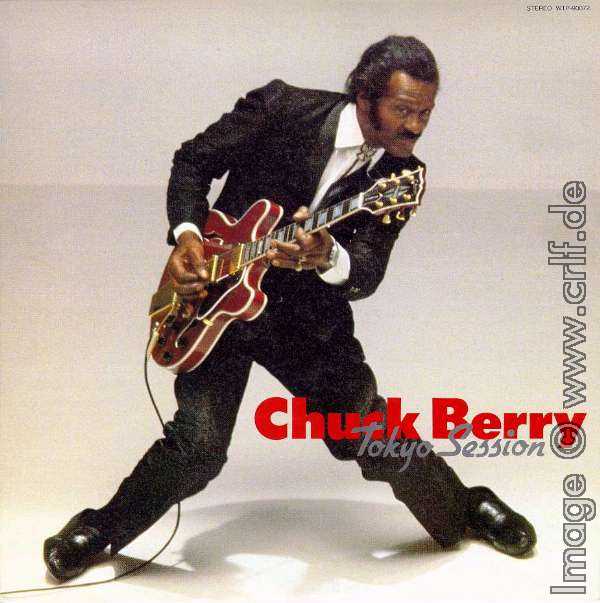
Because this album was distributed in Japan only, it is one of the rarer official Chuck Berry LPs.
A couple of weeks ago and within a few hours two readers of this site informed me about a video on YouTube which is related to this album - and which changes some data we thought to know about the album.
Here are a few pages from the 1981 tour promotional book courtesy of Claude Schlouch collection:
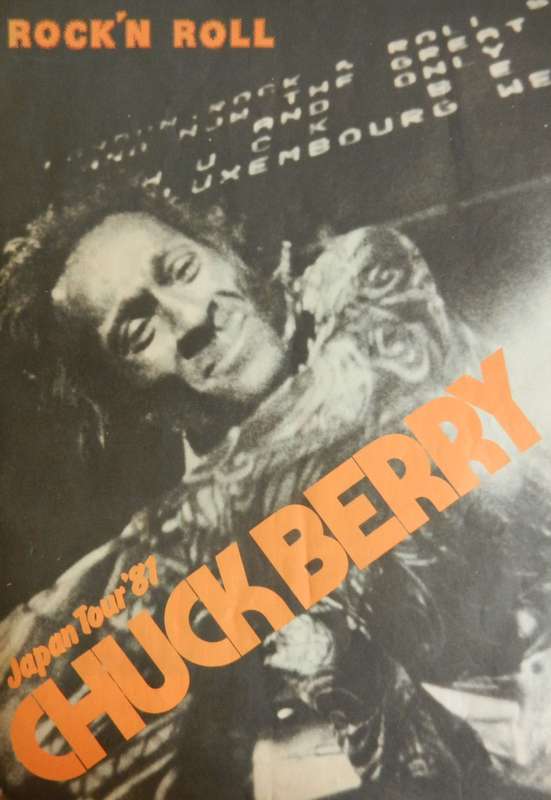
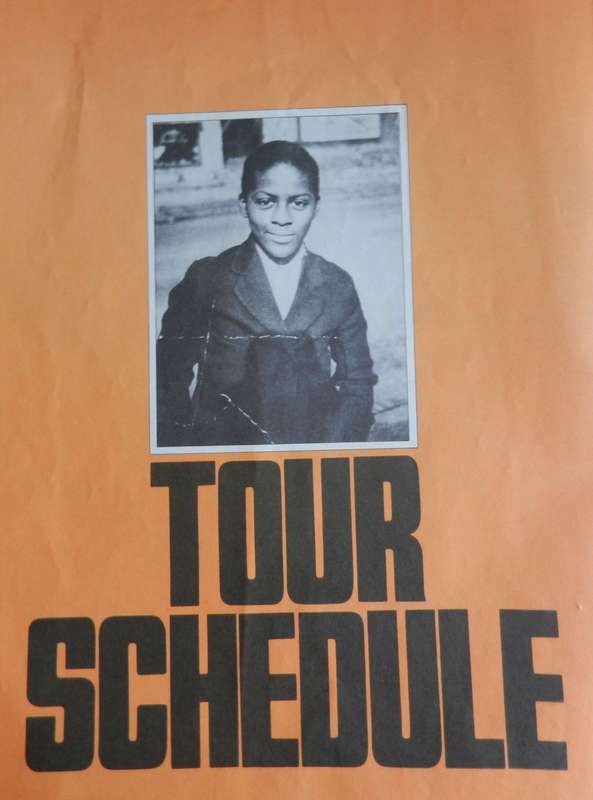
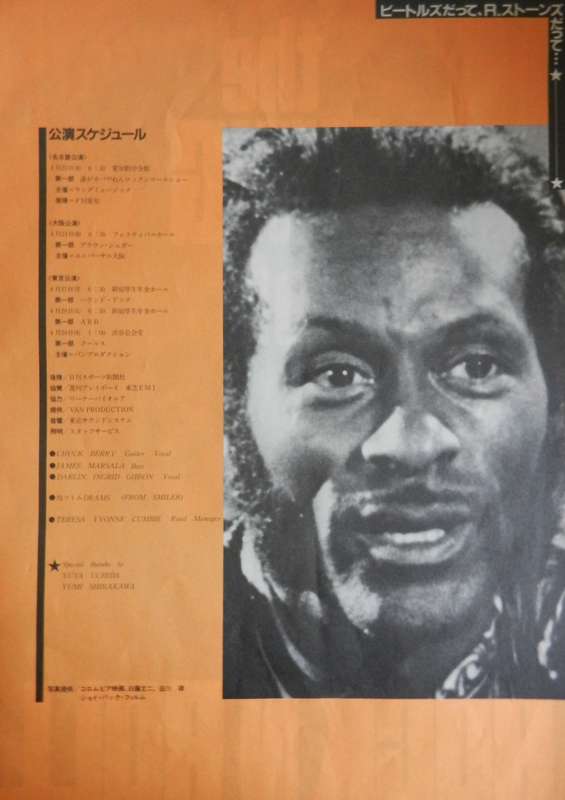
If you cannot read Japanese (such as I), here's a translation of the most important facts, i.e. the venues and dates:
| Date | Time | Town | Concert Hall |
|---|---|---|---|
| Thursday, April 23, 1981 | 6:30 PM | Nagoya | Aichi Kinro-Kaikan |
| Fridayday, April 24, 1981 | 6:30 PM | Osaka | Osaka Festival Hall |
| Monday, April 27, 1981 | 6:30 PM | Tokyo | Shinjuku Kosei-Nenkin Hall |
| Tuesday, April 28, 1981 | 6:30 PM | Tokyo | Shinjuku Kosei-Nenkin Hall |
| Wednesday, April 29, 1981 | 1:00 PM | Tokyo | Shibuya Kokaido |
According to the information printed on the album cover, the LP's ten or eleven songs (Carol as usual blends into Little Queenie to form a medley) were recorded during the third and fifth show of this tour. The album cover does not tell which song was recorded where. Fred Rothwell therefore had listed the album's first side with the April 27 concert and the second side with the April 29 concert, though saying that this is just a pure guess.
Now back to YouTube. Using the link https://m.youtube.com/watch?v=R6a6H8Cmrcc you'll find a video called Chuck Berry - Tokyo Session (1981) uploaded April 2014. It's not a video at all, just an audio recording played to a fixed image of the tourbook and a ticket. Both the ticket and the YouTube explanation say that the audio was recorded on April 29, 1981 at Shibuya Koukaidou. This means that this is from the same show also the LP was cut from.
This however is NOT - as one would asume on YouTube - a bootleg copy of the LP album. Instead it is a live recording which has no duplicates with the album - songs which are on the album and in the video are different.
If we assume that the date and location of the Youtube audio track are correct and if we consider the high quality of the Youtube recording, my theory is that the unknown poster had access to the concert recording segments which were not used for the LP.
The YouTube show starts with an MC introduction and ends with Berry's typical closing routine. However, this is not a complete show. If you listen closely you will find that it consists of two parts glued together. There is a break right after Let It Rock and before the Carol medley. And if we assume that Berry played his usual set of 60 minutes (according to one collector, Japanese concerts typically last only 45 minutes) there is a segment missing in the middle of the YouTube video.
In my opinion we have here the beginning and the end of the Shibuya Kokaido concert, while its missing middle part has been used for the album. If it is, we can listen to the album and see if we can find out which songs might fit into the middle of this 29th concert - and which songs are definitely not, thus have to be from the 27th. I just did. This is my list of comments. Please check for yourself.
LP side A:
- School Day - might be a separate track since Roll Over Beethoven starts pretty surprisingly
- Roll Over Beethoven and Wee Wee Hours flow into each other pretty continuously (which could be a post-processing trick, though)
- Wee Wee Hours starts with the Blues explanation. Since that is on Sweet Sixteen on the YouTube recording, it's probable that this track is from a different concert, i.e. from the 27th.
- My Ding-A-Ling is separated from Wee Wee Hours. It includes Ingrid's introduction, though, and as such must also be from the 27th.
- Memphis follows My Ding-A-Ling smoothly and since the Youtube recording has no space to put another Ingrid track in, this has to be from the 27th as well.
LP side B:
- Sweet Little Sixteen blends smoothly into Rock and Roll Music
- Rock and Roll Music is in the YouTube video and different, thus has to be from the 27th.
- Carol/Little Queenie as well
- Bio has no audible gap to the Carol/Little Queenie medley before and to Johnny B. Goode following.
- Johnny B. Goode again can be found in a different version as part of the YouTube video.
Thus of all LP tracks only School Day fits into the middle of the YouTube recording. The most probable sequence of the songs therefore is:
April 27th:
- Roll Over Beethoven (LP)
- Wee Wee Hours (LP)
- Sweet Little Sixteen (LP)
- Rock And Roll Music (LP)
- Carol / Little Queenie (LP)
- Bio (LP)
- Johnny B. Goode (LP)
- My Ding-A-Ling (LP)
- Memphis (LP)
- (probably) Reelin' And Rockin' or some other closing routine (unreleased)
April 29th:
- Roll Over Beethoven (YouTube)
- Rock & Roll Music (YouTube)
- Sweet Sixteen (YouTube)
- Let It Rock (YouTube)
- School Day (LP)
- Carol / Little Queenie (YouTube)
- Johnny B Goode (YouTube)
- My Ding A Ling (YouTube)
- Reelin' And Rockin' (YouTube)
Fred agreed to use this sequence in further editions of his discography - until we get more data.
[Many thanks to Claude Schlouch, Thierry Chanu, and Naoki Suzuki for help with this article.]
Thursday, February 5. 2015
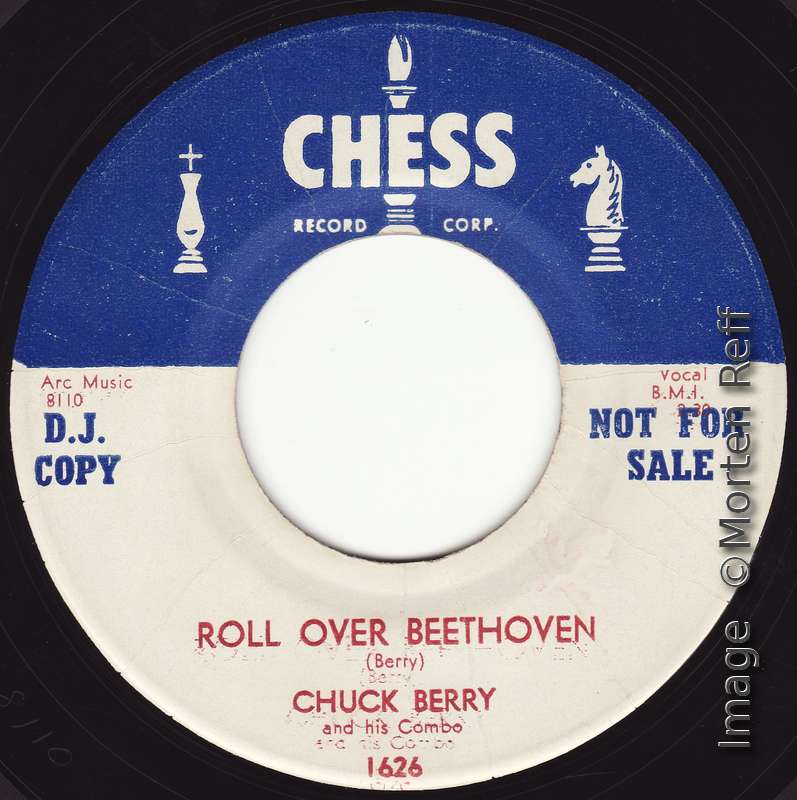
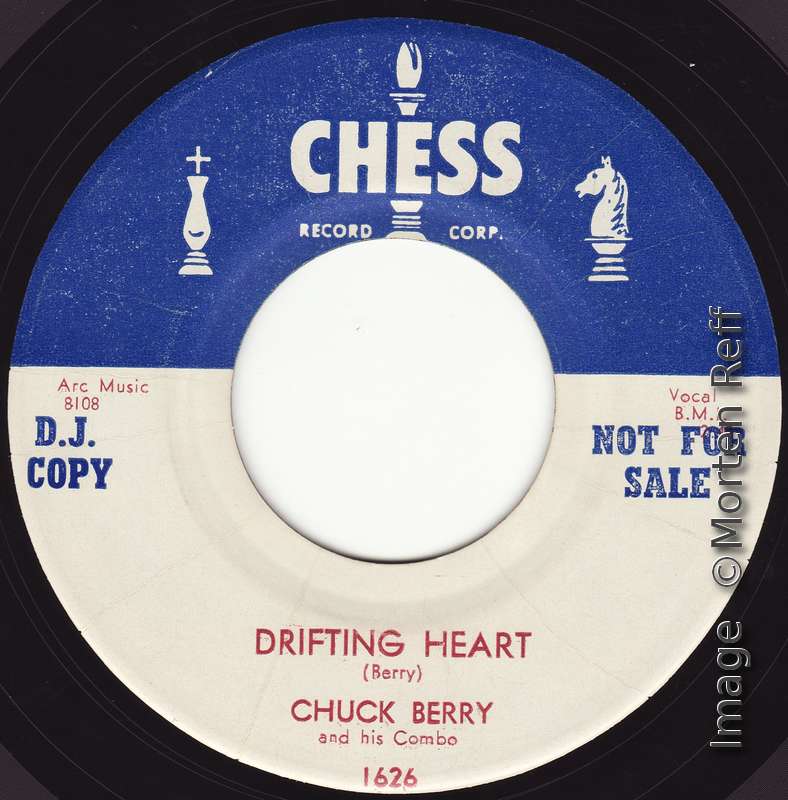
CBID - How Chess DJ Copies look like
CBID is never complete as new records and CDs appear and some old rarities are discovered. This section presents interesting additions and corrections to CBID.
Today: Some rare images of Not-for-resale records
CBID not only lists, but also shows many of the most interesting Chuck Berry records. Here are the labels of two very interesting records: DJ copies of early Chess releases.
CHESS 1604
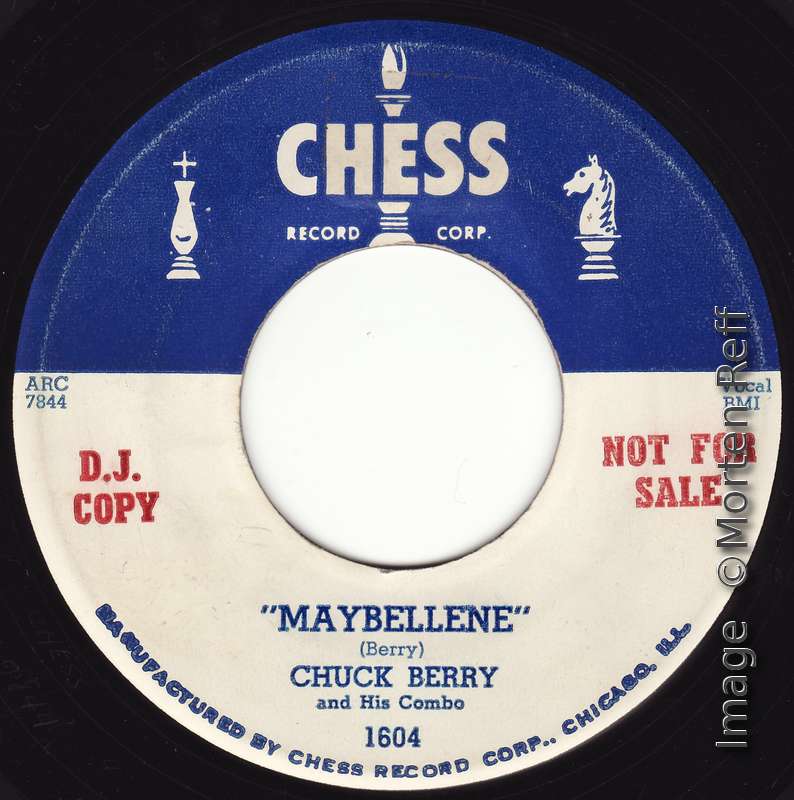
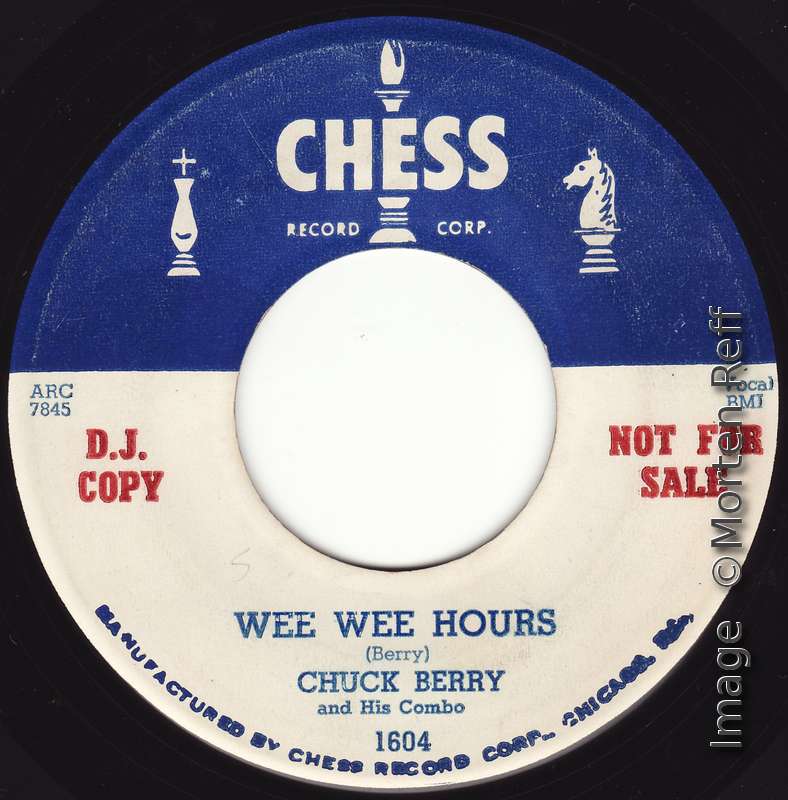
CHESS 1626
Thursday, January 22. 2015
New And Verified Information About Chuck Berry's 1950's Recording Sessions
The earlier information has been built up over the years from various publications. For instance the session which created Roll Over Beethoven has for many years been placed in February 1956. I think this was stated first in an early edition of Blues Records. This date was then subsequently used in the discography on the sleeve of Golden Decade Vol 2. as well as in the books by Howard DeWitt and Michel Ruppli. Chuck's discography in his autobiography listed the recording date as April 16, 1956, though. This is what I used in Long Distance Information: Chuck Berry's Recorded Legacy (Music Mentor Books, 2001). On the recording contract the date is stated as April 19, 1956 and I feel this is the most reliable info we have.
Likewise a lot of information about personnel has built up over the years. Blues fans would ask artists about old sessions and I'm sure some guys like Willie Dixon would try to placate fans by giving info that was not always correct. Lafayette Leake was a big friend of Willie's and I suspect he got named as pianist for wont of someone else at times. Johnnie Johnson was not part of the Chess studio clique (he never recorded in his own name at Chess) and I think he may have been overlooked. The contract information now gives us some more reliable data as the contracts list names, instruments and the local musicians union code the musicians were assigned to. The recording of the names is a bit haphazard and it seems like they are phonic interpretations of names (Odie for Otis; Thompson for Thomas etc.). But remember Chess had far more interest in making a hit record than recording musicians names.
All the musicians named on the RoB session (except Dixon) were in the St Louis local musicians union (197) so it seems all the musicians on the 1956 session traveled up with Chuck. Roy Davis is Leroy Davis - sax, Melvin Billups was a St Louis drummer, Vincent Pitts was a trumpet player (both recorded with other artists). I always thought there was a trumpet on Roll Over Beethoven (listen to the very end note) but recently dismissed it, have I now reinstated it.
This is how I understand the recording contracts and this is how I will list these sessions in future publications:
The 16.4.56 Session
New:
April 19, 1956; Chess Records Studio, 4750-2 South Cottage Grove Avenue, Chicago, Illinois
Chuck Berry & His Combo: Chuck Berry: vocal/guitar; Willie Dixon: double bass; Melvin Billups: drums; Johnnie Johnson: piano; Leroy C. Davis: tenor saxophone (except Brown Eyed Handsome Man), Vincent Pitts: trumpet (on Roll Over Beethoven)
The 6.1.58 Session
This session produced Johnny B. Goode and the contract details give Johnnie Johnson as pianist!!!!!! It is strange Johnnie's name appears against JBG especially as both Chuck and Johnnie said he didn't play on the recording (even more strange that neither parties' lawyer picked up on this fact even though they had access to the session contract). However, we have it in black and white on a contemporary document which for me is better than trusting the memory of musicians for whom the session was but a fleeting moment in time without any historic significance.
Therefore:
January 6, 1958; Sheldon Recording Studio, 2120 South Michigan Avenue, Chicago, Illinois
Chuck Berry: vocal/guitar/overdubbed guitar (on the released version of Johnny B. Goode); Willie Dixon: double bass; Jasper Thomas: drums; Johnnie Johnson: piano
The 27.2.58 Session.
The previously listed date differs by one day from the date on the contract which also gives personnel for piano, drums and bass. Bob Bushnell was a bass player who went on to play with Elmore James, Dylan, Hendrix.
New:
February 28, 1958; Sheldon Recording Studio, 2120 South Michigan Avenue, Chicago, Illinois
Chuck Berry: vocal/guitar; overdubbed second guitar/steel guitar (on Blues For Hawaiians); Bob Bushnell: bass; Jasper Thomas: drums; Johnnie Johnson: piano
The 12.6.58 Session
The contract info gives the date of June 12, 1958 and includes different personnel to previous publications. Willie Dixon is listed instead of George Smith, and Odie Payne in place of Hardy or Thomas. Rather than Johnnie Johnson the pianist is given as Paul Cayton from the New Orleans local musical union. This probably is a miss-spelling for New Orleans pianist Paul Gayten who recorded for Chess and was their agent / musical fixer in New Orleans. The elusive George Smith (who is not the famous harmonica playing Little George Smith) doesn't seem to appear in any other Chess Recordings and has been removed from the line-up.
According to the contract this was a Double Session and also produced the recordings previously listed as from a separate session dated April 20, 1958.
The songs given are also interesting with some alternative titles. Beautiful Delilah is typed in as "Rebecca and Delila" with "Rebecca" crossed through and "Beautiful" pencilled in. The original title for Vacation Time / 21 is listed as "When You're Twenty-One". Hey Pedro is typed in as "Lazy Pedro" with "Lazy" crossed through and "Hey" pencilled in. "Blues Of Hawaii" seems to be another try at Blues For Hawaiians which remains unissued / lost.
Therefore:
June 12, 1958; Sheldon Recording Studio, 2120 South Michigan Avenue, Chicago, Illinois
Chuck Berry: vocal/guitar/overdubbed guitar; Willie Dixon: double bass; Odie Payne: drums; Paul Gayten: piano
The 28. 9 58 Session
There is a discrepancy in the date by a couple of days as the contract states 26.9.58.
The piano player is given as Otis Spann rather than Johnnie Johnson which is a surprise as this session may have produced Long Fast Jam and Slow Fast Jam which are felt to be archetypal Chuck & Johnny cuts!! The date on the tape box for these two instrumentals is just "9/58" so I have split this session and name Spann as pianist on Anthony Boy and Sweet Little Rock And Roller. From the contract we also learn that Memphis (as "Long Distance Telephone", crossed through and "Memphis" pencilled in) and Jo Jo Gunne (as “Joe Joe Gun”) were recorded at this studio date. This is at odds with the reminiscences about the recording of Memphis by Chuck in his autobiography in which he says it was cut by him alone in his St Louis office. I don't doubt that Chuck did record a demo in St Louis on his $79 reel-to-reel Sears-Roebuck tape recorder but my feeling is that the finished cut was produced in the studio. This also goes for Jo Jo Gunne where the off-mic shouts have a studio ambience. Chuck also contradicts himself in that in his song list at the back of his book he lists the four song titles as being recorded at one date. Finally by placing the two songs in this session, the matrix numbers now run consecutively.
Therefore:
September 26, 1958; Ter-Mar Studio, 2120 South Michigan Avenue, Chicago, Illinois
Chuck Berry: vocal/guitar/overdubbed guitar; Willie Dixon: double bass; Jasper Thomas: drums; Otis Spann: piano; band: vocal (on Anthony Boy)
Songs: Anthony Boy, Jo Jo Gunne, Sweet Little Rock And Roller, Memphis
September 1958; Ter-Mar Studio, 2120 South Michigan Avenue, Chicago, Illinois
Chuck Berry: guitar; Willie Dixon: double bass; Jasper Thomas: drums; Johnnie Johnson: piano
Songs: Long Slow Jam and Long Fast Jam
The 19.11.58 Session
The only variation here is that Odie Payne is given as the drummer in the contract details rather than Fred Below.
Therefore:
November 19, 1958; Ter-Mar Studio, 2120 South Michigan Avenue, Chicago, Illinois
Chuck Berry: vocal/guitar/overdubbed guitar (except on the LP version of Merry Christmas Baby and That's My Desire); Willie Dixon: double bass; Odie Payne: drums; Ellis 'Lafayette' Leake: piano; unknown tambourine (on That's My Desire)
Sunday, December 21. 2014
Fred Rothwell's Chuck Berry Discography Download
Several readers asked whether this discography would be available as a PDF file because they'd love to add some handwritten notes without damaging the great book. Others asked for a list where they could highlight the recordings they already have or those they still miss.
Due to this Fred prepared a simpler version of the discography. It contains all the information from the Bear Family book plus a few corrections. It omits the fancy layout and the colorful images, though. And like in the Bear Family book it contains just the period between 1954 and 1979 and only the musical recordings, thus omitting the interviews and the later (live) recordings. All this additional stuff as well as lots of background information, stories and session details can still be found by getting Fred's book Long Distance Information: Chuck Berry's Recorded Legacy (Music Mentor Books, 2001
 ).
).You can download Fred's 32-page document from this link:
Fred Rothwell: The Chuck Berry Discography 1954 - 1979
Many thanks to Fred for providing us with this document!
Thursday, December 18. 2014
Tim McFarlin Introduces the Berry-Johnson Test into American Copyright Law

I am not talking about the multiple conflicts with U.S. laws Berry ran into during his lifetime. No, Chuck Berry may – at least indirectly – have an impact on future U.S. copyright laws.
Timothy J. McFarlin, a researcher and professor at the Saint Louis-based universities Washington and Fontbonne, was so kind to send me a preprint of a paper discussing necessary changes to the legal aspects of songwriting and recording (as well as creative work in general). The full 95-page text is to appear under the title "Father(s?) of Rock & Roll: Why the Johnnie Johnson v. Chuck Berry Songwriting Suit Should Change the Way Copyright Law Determines Joint Authorship" next year in the Vanderbilt Journal of Entertainment & Technology Law. You can read it right now from the Social Science Research Network at http://ssrn.com/abstract=2530741.
Tim McFarlin discusses a special detail in U.S. copyright laws, namely how current law determines what is called "joint authorship". This is a question which arises when two or more people contributed to a common work such as a song. Usually when two composers worked together to create a song, they own a shared copyright and are listed both. Typical examples are Lennon-McCartney or Leiber-Stoller.
Composers who work together usually have some kind of contract or agreement on how to claim copyright of the resulting works. If they don’t or if one of them questions the agreement, a judge or jury needs to decide who wrote the piece and who owns the copyright.
Now what has Chuck Berry to do with this? Berry was the defendant in a well-documented lawsuit which basically revolved around this exact question.
In 2000 Berry’s long-time pianist Johnnie Johnson filed a suit against Chuck Berry claiming that he, Johnson, co-wrote 42 songs published under Chuck Berry’s name in the 1950’s and early 1960’s. This would have entitled him to both be listed as a co-author and to gain half of the financial success these songs created – which Johnson’s lawyers estimated to an amount of at least $6.2 million.
Johnson lost the case in the end. It was never determined whether or not he co-wrote the songs and whether he could qualify as a co-writer. The court ultimately ruled that the statute of limitations had expired, meaning that Johnson was required to have filed his claims no later than three years after he knew or should have known that Berry was claiming sole authorship of the songs.
Because this expiration was unclear first – Johnson’s lawyers claimed that he was tricked into believing that he had no rights to the songs – the parties to the case concurrently investigated how these songs were created and whether Johnson qualified as a co-author at all. To do so, they let Berry and Johnson explain how they worked in the 1950’s and early 1960’s.
On June 19-20, 2002, Johnnie Johnson was interviewed under oath in a deposition by Chuck Berry’s lawyers. Berry’s deposition by Johnson’s lawyers took place two months later on August 21-22, 2002. These resulted in over six hundred pages of transcript which are now for the first time used for scientific research. Tim McFarlin cites a lot from these protocols which therefore makes his paper an interesting read even if you don’t care about the legal aspects.
If I understand Tim’s ideas correctly, he complains that in current U.S. copyright law one of the main arguments whether or not a contributor is a co-author (and an argument which courts test against) is that the contributor (or both) regards himself as an author. And the contribution must have been copyrightable by itself.
Both requirements do not fit to what we see in the collaboration between Berry and Johnson – or any other contributors to recorded music. The copyright laws assume that a sole author (or a team) in advance prepare a copyrightable work. This might happen in song recordings if you look at a big band or orchestra where a composer or arranger clearly writes down the notes each instrument is to contribute at a given time.
This however is not how a 1950’s recording of a Rock ‘n’ Roll band worked. From the testimonials quoted here we understand that Berry basically wrote down the lyrics. Probably he also had in mind or on paper the melody he would sing these words to – and maybe even his guitar accompaniment. But Berry might have in mind but not in writing what for instance the drummer or the bass player should contribute. He just let the musicians do their best – which is what he selected them for.
Thus if a musician came up with let’s say a significant bass line or a great piano solo, this hasn’t been part of Berry’s original composition – and thus his copyrightable work. We know of several Berry recordings where Johnnie Johnson provided more than just a standard blues or boogie accompaniment to the songs. A nice example to me is You Never Can Tell, where the piano almost provides a second voice.
As Tim McFarlin points out, even if Johnson was the author of these contributions and even if those would provide a significant element of the copyrighted work, Johnson would still not qualify as a joint author because his work would not pass the typical tests. Please read Tim’s paper to understand the legal arguments. Basically Johnson never intended to be a co-author and thus he couldn’t become one.
This is a bit different from the understanding of authorship in other countries, such as here in Germany. Here you do not have to intend to be an author. Simply by the act of writing (or composing) you create a work and then you own the copyright in it. This is much simpler than in the U.S., but might result in similar problems for a judge to decide whether a contribution is worth a share in the copyright.
Tim McFarlin comes to a similar result by proposing a new test for joint authorship which does not rely on the intention to become an author but on the intention to jointly create a work. In this example musicians came together to jointly contribute to the creation of a song (at least if Johnson’s testimony is to be believed) or at the very least to jointly contribute to the recording of the song, so all of the substantial contributors to the song (Tim details how he thinks “substantial” should be determined) should qualify as its co-authors, just as all substantial contributors to the recordings should qualify as its co-authors. (Under U.S. law, a song and an audio recording of that song are separately copyrightable, but here Johnson only sued for credit as co-author of the songs, probably because the copyrights in the recordings were unambiguously owned — at least originally — by Chess under recording contracts that Chess had with Berry and the rest of the band.) Because McFarlin’s test stems from evaluation of the Johnson v. Berry case, Tim names it the "Berry-Johnson" test. One might see this as an honor for Chuck Berry – or probably not.
For readers of this blog the most interesting elements of Tim’s paper are his quotes from the sworn testimony of Johnson and Berry. These provide a quite open look at how recording went during the old days at Chess studios. Here are a few quotes cited in Tim’s article. As these are taken from oral questions and answers, punctuation and grammar are quoted as in the protocols.
Johnnie Johnson on work at Berry’s home in Whittier:
[W]hen we first started, he didn’t have a studio, we were mostly running over these songs at his house, and then after awhile [sic] he got this studio on Easton, and that’s where we did most of the work at.
Johnnie Johnson on Leonard Chess’ contributions:
Most all of them was in final form, at least we thought they were in final form, until maybe Leonard Chess would suggest something we did. [H]e would take the tape that we took him, he would listen to it and he would suggest something that he maybe thought could be improved, he would make a statement about it and we would maybe try what he thought would improve it; if it did, that would go on the record; if not, we would leave it as is.
Johnnie Johnson about whether drummers Jasper Thomas or Ebbie Hardy should be considered as among the composers of these songs:
No. Because they’re not playing music, they’re just keeping time.
Chuck Berry trying to explain to a lawyer that a song is not complete until on record:
[T]here was no Wee Wee Hours before, there was no music to Wee Wee Hours before Wee Wee Hours was Wee Wee Hours. Wee Wee Hours became Wee Wee Hours after we had recorded it, it was named Wee Wee Hours. We physically put it on the record. The name, the title Wee Wee Hours became the title of Wee Wee Hours before Wee Wee Hours.
Chuck Berry still trying to explain the same thing:
I could change this to all of these songs were created [in the session], because a song is not, to me, is not a song until it’s confirmed, it’s confirmed in the session when we say, okay, this is this song, if it bears the same title that we brought up. [I]t’s not that song until it’s there. [A]ll the other things were rejected and they became no song until the final song. [I]t isn’t that song until after it’s named that song and then put down on a record and came out that way.
Chuck Berry about the complexity of songs such as Wee Wee Hours:
Well, I think that Wee Wee Hours, it’s so simple, I think I showed him [Johnson] what to play. I could have played it, because it’s simple, it’s very simple, and what I played with my left hand is progression, and any person would follow with that same thing if they heard the top.
Chuck Berry about his own songs:
My songs are, my own songs rather than copying Route 66 or a Nat Cole song, they’re so simple that you can play one song and sing the lyrics to another song.
Chuck Berry about the early Chess recordings:
I’m trying to think if we ever did any rehearsing at the Cosmopolitan, and that’s about the only place that we would have, because most of these songs I created actually in the session, we might have played songs like it, like Roll Over Beethoven is about the same progression as Johnny B. Goode, or Carol. Rock and roll is so simple that you can hardly distinguish any specifics about either song.
Chuck Berry about his understanding with Johnnie Johnson:
[T]here was a harmonious understanding after a few recordings, that when I stop singing, Johnnie played this riff, or that riff, and there are certain ones that I can name. I could implicate the rhythm and he would remember the thing that I liked so much, and the same thing would happen, turned around, when I would play the riff, that I’d ask him to play a certain thing, seemed like to me, he would just fall in.
Chuck Berry on how his songs were created:
Mostly [] all of my songs [] began with what I strum with the guitar, just a strum, chord for chord for chord as the changes go, and along with the lyrics that I’m singing with it, so this is a good progression, I mean, manner in which a song travels in changing chords and so forth. I’m singing the melody along with this, and as I introduced the songs to the musicians at a session or wherever it is, a jam session behind any auditorium, I will play that and sing that, you know, they get an idea of how the song progresses.
Chuck Berry on originality and copyrights:
I believe there is nothing under the sun that hasn’t been played, and now, with the years that I have, there is nothing, there is no riff under the sun that Johnnie has not heard or I have not heard; so, you play, it might come out and it belongs to someone else, you take the chance that it doesn’t, and you go ahead and you record it; [] if it sounds good and meets what you wanted on the song or is equal to what you wanted in the song, let it go, it’s a song, you don’t know whether it will be a hit or not, so it goes, and nobody is writing it down saying ‘I own this’, and ‘I own this’, or ‘This will be good for the song as a copyright’, or anything, nobody knows that until after the song is played out there in the world.
Chuck Berry on what makes a song:
You know, since I consider the lyrics, some of the lyrics in my songs is the whole song, especially like Johnny B. Goode, most of my songs are just boogie, but lyrics, I guess, carried them through, No Money Down, Roll Over Beethoven, I know Beethoven had, but I think the lyrics of my songs kind of pushed them more so than the music, because I’m playing just boogie-woogie, like Count Basie, Lionel Hampton, Tommy Dorsey, those are the people that drove me to playing, you know.
Chuck Berry on to what extent Leonard Chess decided what went on record:
His glory and my privilege, because I wanted to record. I had the inspiration that, I guess, any youngster would have, as long as you record me, I’ll do what you say, I’ll record anything, you know.
Chuck Berry on developing Roll Over Beethoven:
Roll Over Beethoven is a twelve-bar blues boogie, twelve-bar boogie blues, the music was not developed, it was just played boogie in C, and believe me, there is nothing different from playing boogie in C and hearing the lyrics to – what was the song you said? Roll Over Beethoven, Johnny B. Goode, you name it, all of the songs could carry the same background or music that each other has. So, how did the music develop? Johnnie played boogie in C, I sing the song, once my singing is a comparable and the music is in tone quality and volume, that song is made. [How about the guitar?] Well, the drum, too, for that matter, all of that has to coordinate, you know, with, what do you call it, favorable to the record owner, to the Chess Company, to Chess himself, if it’s favorable, if it sounds good, once we get it to sound good on one take, that’s a song, that’s what I mean.
The basic question of whether Johnnie Johnson should have been granted a partial copyright on some Chuck Berry songs remains open. The court did not decide. Johnson supporters such as George Turek and his stepson Travis Fitzpatrick will probably have no doubt. They also had Johnson trademark the line "Father of Rock & Roll" which, as Berry is also often called the Father of Rock & Roll, led Tim McFarlin to the title of his paper: "Father(s?) of Rock & Roll".
My personal opinion is that Johnson for the most part of Berry’s songbook did provide a great underlying piano foundation, though not necessarily more than any other good pianist could have provided as well. Therefore for all of the great hits I agree with Chuck Berry in that the lyrics and the melody make the song. This is what would end up in sheet music, and this is what should be regarded as copyrightable. The Johnson v. Berry case did not give us a definite answer whether Berry wrote the melodies of his major hits all alone, or along with Johnson, or with someone else.
Setting the big hits aside, there are several Chuck Berry recordings for which Berry has been listed and registered as the sole composer – often many years later – in which Johnson plays a major, if not the major role. Have a listen to the recently discovered Fast B6. This is a pure piano piece and nobody should say that this is a Chuck Berry composition. Or, to take one song which was recorded in the 1950’s but interestingly not disputed in the trial, listen to Blue Feeling. This is a song which should have been credited at least to Berry-Johnson, if not Johnson alone. However, since Johnson died in 2005, all that is left on the subject is current and future scientific research.
One more sidenote: From Tim McFarlin’s paper we also learn the correct spelling of Ebbie Hardy’s name. Drummer of the original Johnson/Berry band, Hardy’s first name has been spelled Eddy and Ebby in former publications. Tim got the correct spelling from Ebbie’s grandson.
Tuesday, December 9. 2014
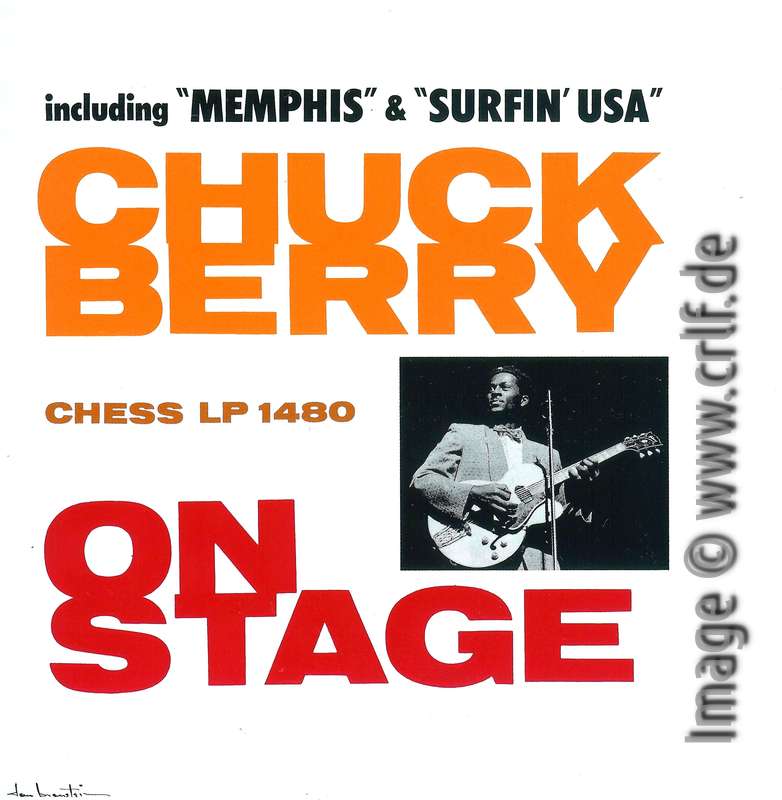
Chuck Berry On Stage - The Sticker Version of CHESS LP 1480
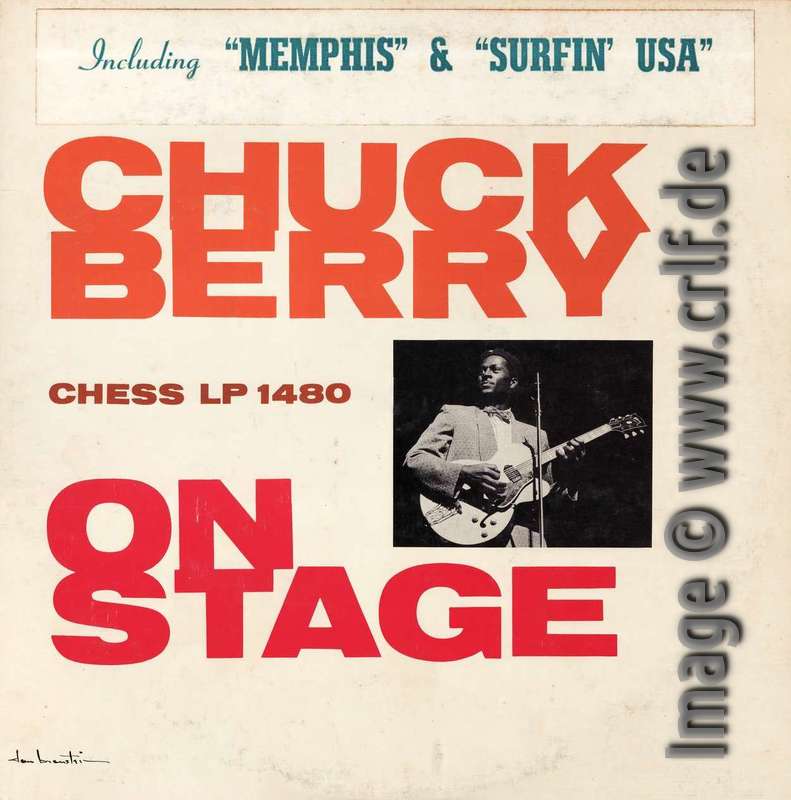
This blog article is a true collaboration between Morten Reff and me. Here are the results of our joint research on Chuck Berry On Stage, the original CHESS album from 1963.
When Morten described Berry's seventh CHESS album on page 60 in his Chuck Berry International Directory, Volume 1, he noted:
The original pressings of this LP had a sticker on the front cover saying 'Including "MEMPHIS" & "SURFIN' USA".As you know, all later variants of this album had this text printed directly on the cover, using a different font style and color. (Look at the end of this article if you don't remember.)
So when in August I found an eBay offer of a copy having the title sticker, Morten did not hesitate to buy it - even though it was quite expensive.
This finally allows us to show an image of the original cover of CHESS LP 1480. (Click for a higher resolution image.)
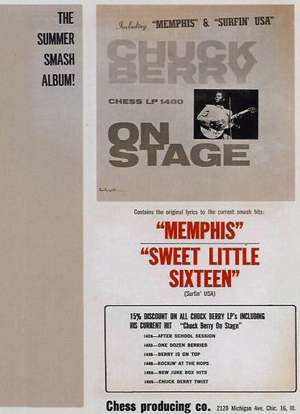
A contemporary ad from Chess showed a black and white image of the sticker version of the album. And the sticker seems to be applied hastily just before the photo shooting as crooked as it is.
Though now having this extremely rare variant opens another set of questions:
When receiving the album, Morten found
"The copy I bought features the second label, the black label (repress) image on page 60."So how does a later vinyl make it into the original first sleeve? Two answers are likely: Between 1963 and 2014 someone might have replaced the original vinyl with a repressing, given the original record being defect or broken. Or, as Morten knows, CHESS usually pressed more covers than vinyl albums, so what they had available were used. Thus in the factory someone might have taken an old original cover from the box at the bottom of the stack when packing the newly pressed albums.
We can only speculate on this. But what is even more interesting to know is: "Have there been sold any copies of this album which neither have the printed text nor the sticker?"
We won't remove the sticker from this valuable album, but we both expect it to have no printing under the sticker. So we think the very first printings of the cover did not include any reference to Memphis or Surfin' USA. What we now found, might indeed not be the very first variant of this cover. It might already be a second variant, 'enhanced' with the title sticker.
So our question to all Berry collectors reading this blog is: Do you have a copy of CHESS LP 1480 which has no sticker and no printing of the 'including' text? If you do, send us an image and we would be happy to show it here.
During this discussion, we also found that while neither this site nor Morten's book could have shown the sticker variant of the cover, we also failed to show the correct non-sticker variant. On my site I had a later French reissue (which was then also pirated to Wikipedia), Morten's publisher included by accident the British Pye version.
The correct second (or third) cover variant has the label name and number prominently right next to the photo as it can be seen here. Sorry for that. So here's what should have been in the book and on the site.
Thursday, November 20. 2014
CBID - Japanese Promo Sampler containing unusual Mercury recordings
CBID is never complete as new records and CDs appear and some old rarities are discovered. This section presents interesting additions and corrections to CBID.
Today: How Philips promoted Japanese Mercury singles. Add this to the Japan discography published in Volume 1:
JAPAN
St. Louie To Frisco / Soul Rockin'
Mercury SM-1061 ? 1968
This has a great picture sleeve, very similar to the 1968 US LP cover of FROM ST.LOUIE TO FRISCO [µercury SR-61176]. Blue label with silver lettering.
Addition: As a promotional record to DJs and journalists, the contents of this and other singles from Philips Nippon labels was sent out in advance on a various artists album (see Philips DFM-97 below).
(Title in Japanese only)
Philips DFM-97 ? January 1969
St. Louie To Frisco / Soul Rockin'
Promotional LP album issued by Philips Nippon Group containing the A and B sides of newly released singles by various artists and labels. Besides the two songs from Mercury SM-1061 the album includes recordings by The Herd, The Swingle Singers, Tommy James & The Shondells, Gary Walker & The Rain (one song only), Jerry Butler, and The Mauds. Generic picture cover with artist photos, no Chuck. Cue sheet with singles details glued on back cover.
Main Page
This weblog is an addition to my Chuck Berry fansite called "A Collector's Guide to the Music of Chuck Berry" which describes all books and records of interest to everyone enjoying Chuck Berry's music.
Categories
What You Missed
Some earlier but important entries:
- Unanswered questions about the recording of Memphis, Tennessee
- Sweet Little Eight Variants of Sweet Little Sixteen
- The Johnny B. Goode Session
- Chuck Berry in Stereo
- Chuck Berry's Recording Session for Volkswagen
- Chuck Berry's Recording Session for Dr Pepper
- Tim McFarlin Introduces the Berry-Johnson Test into American Copyright Law
- Chuck Berry's Early Recording Locations
- Run! Rudolph, the Red-Nosed Reindeer – and the copyright mystery
- Chuck Berry live in New York 1956
- The very first Chuck Berry LP album
- The Chuck Berry On Stage (Chess LP-1480) confusion continues
- The Chuck Berry Vinyl Bootlegs, Vol. 1: Rare Berries
- Rocksmuk album - bootleg or not?
- 6034 cover versions of Chuck Berry songs
- Chuck Berry's Greatest Hits (Chess LP-1485) variants
Recent Entries
- CBID - Some new and some old covers of Johnny B. Goode
- Monday, May 11 2026
- CBID - Some new and some old covers of Memphis, Tennessee
- Monday, March 30 2026
- CBID - Run, Rudolph, Run, Run, Run
- Wednesday, February 11 2026
- CBID - From Stones to Covers to Vienne
- Thursday, November 27 2025
- CBID - Another Bunch of Berry Covers
- Tuesday, October 14 2025
- The very first Chuck Berry LP album
- Tuesday, September 2 2025
- CBID - Chuck Berry covers online, live, and on record
- Monday, July 28 2025
- CBID - Maybellene versions and other covers
- Wednesday, April 23 2025
- CBID - More Berry Covers and other things…
- Saturday, March 15 2025
- CHUCK100 Tribute EP Series
- Thursday, January 16 2025
- CBID - Corrections, Additions, New Covers
- Friday, January 10 2025
- Rhythm and Rhyme - Chuck Berry’s poetic heartbeat
- Sunday, December 22 2024
- CBID - 6034 and counting ...
- Friday, November 1 2024
- CBID - 6034 cover versions of Chuck Berry songs
- Friday, July 5 2024
- CBID - The Never Ending Story - pt. 9
- Monday, June 10 2024
- CBID - The Never Ending Story - pt. 8
- Tuesday, June 4 2024
- CBID - The Never Ending Story - pt. 7
- Monday, April 22 2024
- Peter O’Neil’s So-Called Disorder
- Friday, April 12 2024
- The Chuck Berry Sound according to Atomicat
- Wednesday, April 10 2024
- CBID - The Never Ending Story - pt. 6
- Wednesday, April 3 2024
- CBID - The Never Ending Story - pt. 5
- Saturday, March 16 2024
- CBID - The Never Ending Story - pt. 4
- Monday, February 19 2024
- CBID - The Never Ending Story - pt. 3
- Monday, February 5 2024
- CBID - The Never Ending Story - pt. 2
- Monday, January 22 2024
- The Chuck Berry Vinyl Bootlegs, Vol. 3: America's Hottest Wax
- Tuesday, January 16 2024
Search
Copyright and Disclaimer
© Dietmar Rudolph
No part of this document may be used or published without written consent by the author.
Impressum/Haftungsausschluss/Datenschutz/Disclaimer
To contact the authors, email to cbguide@crlf.de.